
Showing posts with label nude. Show all posts
Showing posts with label nude. Show all posts
Monday, September 22, 2008


Saturday, February 16, 2008
Too Racy for London
 Lucas Cranach the Elder, Venus, 1532,
Oil and tempera on red beechwood,
37.7 x 24.5 cm. Stadel Museum, Frankfurt am
Main, Inv. Nr. 1125. Photo © : Jochen Beyer, Village-Neuf.
LINK.
LONDON.- Transport for London has refused to display a poster of the “Venus” painting by German artist Lucas Cranach the Elder stating it was overtly sexual. This painting is one of the 70 works that will be on view at the Royal Academy of Arts on March 8 in London. According to the academy, Transport for London would only display the image if the bottom half was cropped out.
Academy spokeswoman Jennifer Francis said, “I think it is because she's totally nude as opposed to say she's topless. We're shocked. We wouldn't have put a poster design forward if we thought it was offensive."
Jennifer Francis stated that the "Venus" was chosen because it best represents Cranach's work, but the academy was uncomfortable altering the artist's work by cropping it. Jennifer Francis stated, "We actually thought it was quite an innocent painting."
Transport for London issued a statement: "We have to take account of the full range of travelers and endeavor not to cause offense in the advertising we display."
An article from Germany.info.
An editorial at Guardian Unlimited.
Thursday, January 25, 2007
ART CLASSIC #1
La Source
by Pierre-Paul Prud'hon
c. 1801
Black and white chalk approx. 21 x 15
by Pierre-Paul Prud'hon
c. 1801
Black and white chalk approx. 21 x 15
 Click on picture for larger image.
Who knew one could capture so much with black and white chalk on blue-gray paper? Neoclassical artist, Pierre-Paul Prud'hon is a master of chiaroscuro. The more important thing to note about Prud'hon is that he is also a master of "touch." In other words, his hand has an sensitive empathy with the actual texture of the subject so that he can duplicate said texture with a high degree of realism. There are parts of this drawing on the outer edge that fade off into gesture, but the figure herself is positively alive with illusionistic tactility. The light and dark of the chiaroscuro shape her figure accurately, but it is the artist's touch that communicates her flesh. From the tension of her hand touching her face, to the natural roundness of her breasts, to the bending and folding of her belly, the viewer gets the clear picture of female flesh (as distinct from male). It is this delicacy and sensitivity that makes Prud'hon a master draftsman.
Drawing is often relegated to a secondary or minor art form. If you go to a museum, you will see rooms of paintings, but rarely rooms of drawings (unless it is a "special" exhibition). Even less common is seeing drawings NEXT to paintings in a museum (unless a drawing is a study for the finished painting next to it). Perhaps it is because drawing is often in black and white and people prefer color, that it has been condemned to be the "wallflower" of all the two-dimensional art forms. It is more often that colored pieces win the prizes in art competitions (unless it is a drawing competition, specifically). I remember being warned when applying to grad schools to put paintings and not just drawings in my portfolio because reviewers would like to see what I could do with color. I was also advised not to major in drawing because it "led nowhere professionally."
Sadly, my little wallflower is my favorite two-dimensional art form precisely because it is so primary and necessary for improving observational skills. I like black and white drawing because sometimes color obscures the facts about form and light. In fact, one definition of "color" is to "reveal BY covering," thereby making color a deception and a paradox. There is truth and simplicity in black and white. I guess what I love about this image is it reminds me that drawing is, in fact, an art unto itself that deserves recognition as such. It isn't merely something you use as a study for another art form, but it exists for its own sake as an object of beauty to behold and contemplate.
* La Source can be found in the permanent collection at the Sterling and Francine Clark Art Institute in Williamstown, MA.
© Stephanie Lewis, 2007
Thursday, December 21, 2006

Thursday, June 22, 2006
Naked World
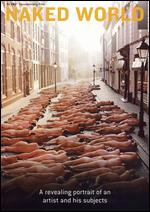 I watched this HBO documentary the other night. It was really quite beautiful seeing the artist's process behind the scenes. He took his camera and his crew to seven continents. It was intriguing learning about the different mores regarding nudity in the models as well as the spectators in the various cultures. Some were quite surprising in this regard. Let's just say France's mores aren't what you think and neither are England's when it comes to nudity. Some people, like the Russians, put a political spin on their nudity.
Spencer Tunick is not considered a photographer or an artist by some, but rather a megalomaniac who is just trying to be famous for doing something big. One does not get that impression from the meek man you see in the film. Whether he is an artist or a photographer or not, he is doing something extremely significant and wonderful. His art exists on three major levels. 1) He makes images that possess poetic expression. 2) He brings people together in large groups for the sake of art. And most importantly, 3) he brings healing to many by emboldening the afraid, the wounded, the overweight, and the scarred by bringing them into community with others who have shed their facades. They all express "transformation" after participating -- some in respect for their bodies, some in respect for other people, and some in terms of reclaiming the ownership of their own bodies. Tunick isn't just making art or photography, he is a healer.
One of the scenes that sticks in my mind in the documentary is when a Christian fundamentalist in Melbourne interrupts a pose involving 3000+ people by getting in front of Tunick's camera with a sign urging people to repent for their sins. The police dragged him off because the city had made the event legal for the sake of art. At first I was exasperated by this man--how could he NOT see the beautiful forest of flesh and healing before him and only see the individual trees? Then, I realized he only saw himself, and that made me sad. Then, I realized the irony of the situation: I assumed he came from a faith that involved an all-nude rapture. Maybe it's wrong on the ground, but not in the air? Then I laughed.
Friday, March 17, 2006
The Male Nude: Style and Substance
This is a very interesting article about the depiction of the male nude over time and context. The two best points made by the author of this commentary are 1) that the Greeks made the body (particularly the male--in the democratic, yet, un-egalitarian culture) a philosophy; and 2) that the body as depicted by Greeks is primarily intellectual and secondarily sexual; the order switches when personal style is introduced. "Greek athletes are abstract," says the author, Jonathan Jones. This is certainly a compelling point.
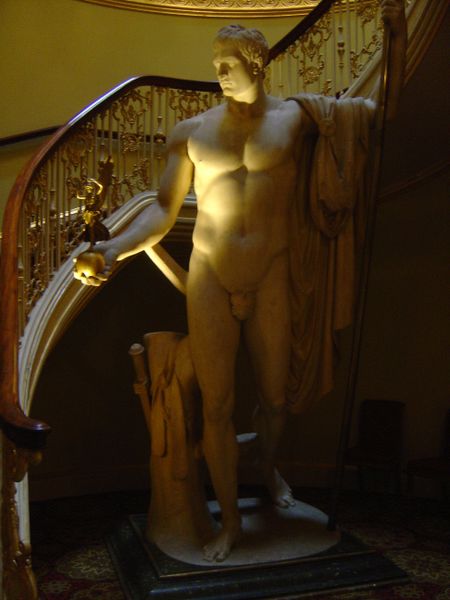
Jones discusses the comedic quality of Canova's statue of Napoleon in the
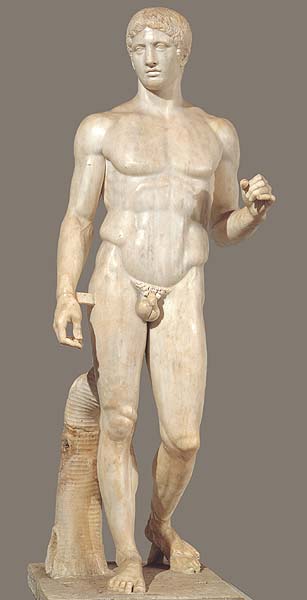 Apsley House--it is both sexual and absurd. Then he takes us through ancient Greece, the Renaissance, the Baroque, and all the way up to modern fashion ads by Calvin Klein and Dolce & Gabbana. Polykleitos's famed canon of male proportions are highly intellectual and abstract; and, even though the character is muscular and nude, sexuality is secondary. Simply by the act of
 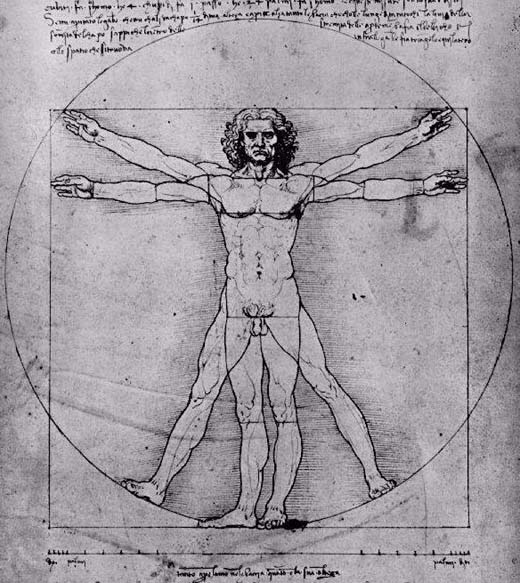 creating a "canon," almost all stylistic sexuality is dissolved. He points how Leonardo da Vinci's "Vitruvian Man" is cosmological and not sexual.
Caravaggio was no idealist. He showed people warts and all, and was not afraid of showing them in an unflattering light (no pun intended). Jones states that Caravaggio's Bacchus is clearly marked with the artist's style, thus sexualizing it. A statuesque figure of a street
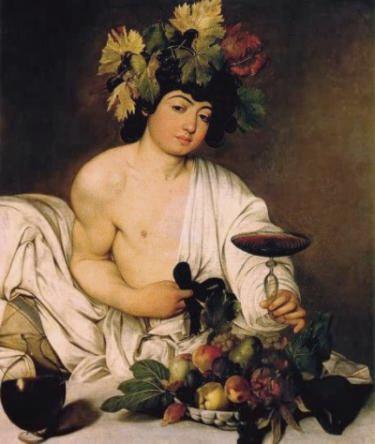 urchin becomes fleshy and real in form and in context/content and connotatively tactile and sensual. In Caravaggio's Deposition, "the nude has b
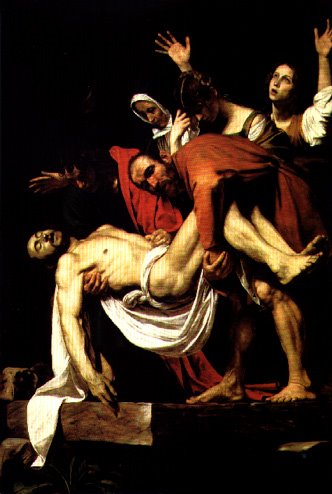 ecome unheroic, pitiful, and human." Donatello's David reeks with stylized sexuality. "David wears leg armour that sets off his nudity. His buttocks are emphasized. The bronze of an adolescent, hand on hip, huge sword in his hand, is mounted on marble and you walk right around him, painfully aware of the sensuality of the polished metal." Jones also argues that Church's denunciation of nudity during the Renaissance and Baroque periods only made the works more sexual/sensual (forbidden fruit).
The ancient Greek masculine figure was a mathematical and philosophical construction--almost too cerebral to be erotic. The figures were regular, systematic, and abstract with "crisp idealism." What actually confronts the viewer's feelings about sexuality (their own in particular) is an artist's particular style, not the nudity itself. This might not seem like a new idea, but Jones elucidates it in a humorous and intelligent way.
Other images mentioned in Jones's commentary....
 Caravaggio, The Victorious Cupid
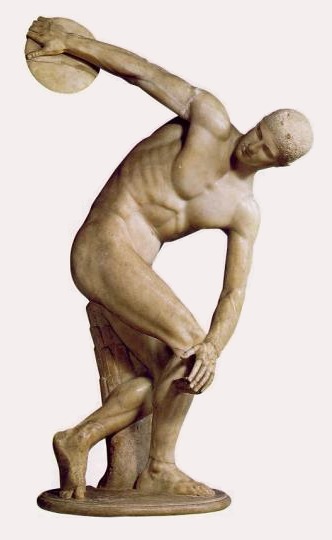 Myron, The Discus Thrower
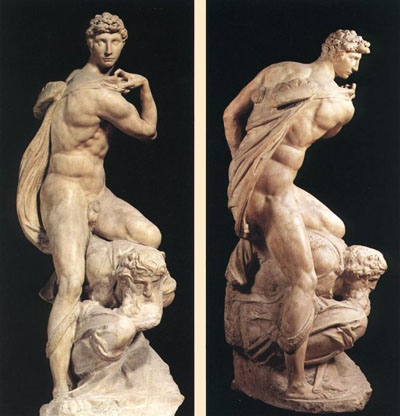 Michelangelo, Victory
© Stephanie Lewis, 2006
Subscribe to:
Posts (Atom)


