Showing posts with label art history. Show all posts

Monday, March 31, 2008

Followup to
Who Says There's No Gender Programming
Blog Entry

Previous Post

Here are some links about the history of gender identity and color:

Princeton Report on Knowledge
Color Matters
How Stuff Works

As an artist and someone interested in art history, I've often wondered what role these two paintings played in the development of the pink-for-girls, blue-for-boys phenomenon:

Jonathan Buttall: The Blue Boy (c 1770)
Thomas Gainsborough (1727-88)

oil on canvas, 70 5/8 x 48 3/4 inches


Sarah Barrett Moulton: Pinkie (1794)
Thomas Lawrence (1769-1830)
oil on canvas, 58 1/4 x 40 1/4 inches

History of Blue Boy:

"The best known painting at the Huntington, Gainsborough's The Blue Boy, portrays Jonathan Buttall, the son of a successful hardware merchant, who was a close friend of the artist. The work was executed during Gainsborough's extended stay in Bath before he finally settled in London in 1774. The artist has dressed the young man in a costume dating from about 140 years before the portrait was painted. This type of costume was familiar through the portraits of the great Flemish painter, Anthony van Dyck (1559-1641), who was resident in England during the early 17th century. Gainsborough greatly admired the work of Van Dyck and seems to have conceived The Blue Boy as an act of homage to that master. Mr. Huntington purchased the painting along with Gainsborough's The Cottage Door and Reynolds's Sarah Siddons as the Tragic Muse from the Duke of Westminster." (1)


History of Pinkie:

"Pinkie, facing The Blue Boy in the Main Gallery of the museum and often paired with it in popular esteem, is by Thomas Lawrence, one of the great portrait painters of his generation. It was painted about 25 years after Gainsborough's masterpiece and had no association with that work until they both were displayed in the Huntington in the late 1920s. Executed when the artist was only 25 and shortly after his election to the Royal Academy, Pinkie is an extraordinarily fresh and lively performance with the sitter standing on a hill, her dress blown by the wind. The movement of her dress in conjunction with her frank gaze gives a sense of immediacy to the composition and expresses the animation of the sitter. The young girl was the daughter of a wealthy plantation family in Jamaica, who came to England for her education. Called "Pinkie" by her grandmother who commissioned the portrait, she was only eleven when her likeness was taken. Sadly, Sarah died within a few months of the portrait's completion, probably of tuberculosis. Her younger brother Edward was the father of the poetess Elizabeth Barrett Browning. Pinkie was the last painting purchased by Mr. Huntington, who did not live to see it installed in the house." (1)

One has to wonder since the two pieces gained tremendous popularity after they were associated with one another in the 1920s. They were reproduced on just about anything one can imagine (coasters, posters, tins, etc.) and reproduced as figurines. In fact, my grandmother had both of them in 10 inch figurines on her dresser. I have no idea where she got them, but they were the most memorable thing about my grandmother's taste in art. Interestingly enough, the two pieces were featured prominently on the Cleavers' walls in the 50s television show Leave it to Beaver.The gender identity of pink and blue had inverted around this time. One has to wonder if this is a connection or just a coincidence.

It just seems strange to "color code" people.


(1) http://www.huntington.org/ArtDiv/HuntingGall.html

Wednesday, March 12, 2008

Mythmaking with George W. Bush

con·fab·u·la·tion (def.)
1. the act of confabulating; conversation; discussion.
2. Psychiatry. the replacement of a gap in a person's memory by a falsification that he or she believes to be true.

Friday, February 01, 2008

Morons

Link

LONDON—United Nations peacekeepers have vandalized prehistoric art in the Western Sahara, spray-painting graffiti over the artwork at Devil Mountain, known throughout the area as a place of cultural significance, the Times (London) reports. The U.N. officers who sprayed the graffiti also signed and dated their work. "I was appalled. You’d think some of them would know better..." said Julian J. Harston, the U.N. representative of the secretary-general for Western Sahaha in charge of the mission there. "They will not enjoy the action we have taken. We will report it to the troop-contributing countries. We can move them." He said he also would seek funding from the United Nations Educational, Scientific, and Cultural Organization (Unesco) to remove the graffiti.

Friday, February 09, 2007

Did Charles Moulton Know About this Image?

I was looking up images of Justice, Lady Justice, and Blind Justice in art history today and stumbled onto this little jewel:

I found the image on the Springfield Museums website. Here's the website's description of the image:

"The Star Spangled Banner, no date
Nathaniel Currier
Hand-colored lithograph

The Star-Spangled Banner, a song written by Francis Scott Key in 1814, was a popular tune during the 19th century, especially at 4th of July celebrations. Though not recognized officially as the national anthem until 1931, Currier & Ives created two different allegorical portraits of freedom using the title of the song as their inspiration. Here, Lady Liberty wears a tiara with a shield bearing the stars and stripes and a veil decorated with stars. She carries the American flag as she strides forward toward liberty. Several phrases from the song emphasize the patriotic nature of the print:

O! long may it wave,
O'er the land of the free,
And the home of the brave"

The resemblance of this Currier and Ives lithograph of Lady Liberty is uncannily similar to that jewel of Americana--Wonder Woman. I wonder what sort of art research, the creator of Wonder Woman, Charles Moulton did to come up with the Amazon's garb. Does anyone else see a striking similarity?

Tuesday, July 11, 2006

Disillusionment

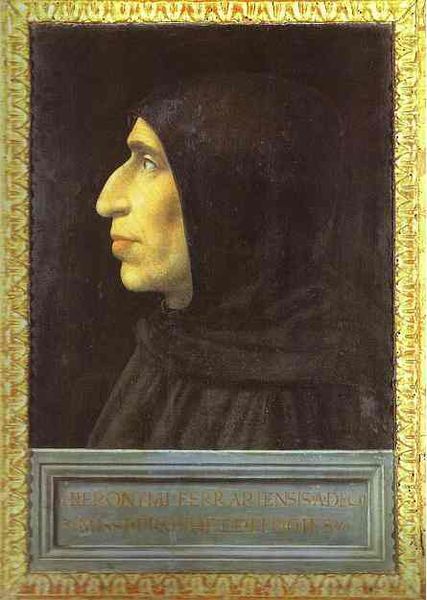
I've been preparing for my Art History II class, looking particularly at 15th century Florentine early Renaissance art. I decided to check into a historical figure a little more deeply. His name is Girolamo Savonarola. When I was younger, I was taught that he was a great early pre-Luther reformer. Turns out, he was an ignorant dictator.

From wikipedia...."They sent boys from door to door collecting items associated with moral laxity: mirrors, cosmetics, lewd pictures, pagan books, gaming tables, fine dresses, and the works of immoral poets, and burnt them all in a large pile in the Piazza della Signoria of Florence. Fine Florentine Renaissance artwork was lost in Savonarola's notorious bonfires, including paintings by Sandro Botticelli thrown on the pyres by the artist himself."

That last line makes me sad. Reformer? I think not.

Bold Move by Greece

They want their art back.

Wednesday, June 14, 2006

Famous Mural Mysteriously Painted Over

This is an outrage. I hope someone figures out who did it. There is a photogallery of the artist's other works on this article's page.


Wednesday, May 03, 2006

You're Only Hurt By the Ones You Love


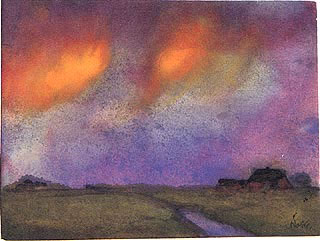
I've long been a fan of Emil Nolde's work--but not his politics. Why would I be? He was a member of the Nazi party for 16 years until he was the most represented artist at Hitler's "Degenerate Art" exhibit (which was held to mock modern art--particularly German Expressionism), and was then forced to quit making art (to the point where the government put armed guards around him to prevent him from doing so). One of his most famous pieces, Crucifixion (1912) was one of the exhibit's centerpieces.


Emil Nolde, Crucifixion, oil on canvas, 1912

It seems at first glance, that to be a Nazi/Fascist is antithetical to being an artist. But, paraphrasing the famous art critic Robert Hughes in the PBS Home Video "Degenerate Art," every artist is a fascist. Personally, I don't put in with lock-step, goose-stepping yes men and women (who generally don't have original thoughts of their own), but Hughes is right about artists (in general) in their individual lives and work. I think what he was saying in the film is that while artists generally don't strive to control others or the world (and this is a good thing, because we know where that goes), they tend to be control freaks over the destiny of their own lives and their creative vision and can grind their heels in like any Nazi in that regard.

One of Nolde's Unpainted Pictures

About a month and a half ago, I checked out "Unpainted Pictures" from the school library. The book contains the work Nolde was forced to do, basically under house arrest. He called these tiny watercolors unpainted pictures. They are mostly landscape and figural paintings that possess the intensity of Chagall's colors. The figural paintings almost always seem to be representing people acting furtively in body language or with their gazes in very tiny formats that accentuate the message they send that is obviously Nolde's message of confinement. The last time I checked out this book, I didn't notice one little tidbit: a copy of the letter from August 23, 1941 from the president of Reichsknunstkammer, Adolf Ziegler, to Emil Nolde, prohibiting him to practice art. I probably didn't notice it the first time because it is in German (which I don't read or speak) and because the caption is in such small type. Well, I found it this time. Luckily, I have a friend and colleague whose mother is German. Recently, she translated it and I thought I'd share it here.... (special thanks to Cindy's mom, and to Cindy)

The President Berlin, August 23, 1941
of the Reichsknunstkammer

(Governmental Chamber)

of Art

Reference number: II B/ M2603/1236


Mr.
Emil Nolde
Berlin-Charlottenburg 9 Registered Mail!

Bayernallee 10


Following the Fuhrer's order to eliminate works of "Entartete Kunst" (degenerate art) found in museums, we had to seize 1052 works by you alone. Many of these had been part of the exhibit "Entartete Kunst" in Munchen, Dortmund and Berlin.


These facts demonstrate that your works do not meet the standard expected from all artists active in Germany since 1933. These include the artists residing here of other nationalities and from other countries. You should be familiar with repeatedly voiced instruction as for the direction and goals of future artistic endeavors that show responsibility towards land and people. Speeches relative to this were given by the Fuhrer at the openings of the "Grossen D.K." ("Important German Exhibits of Art") in Munchen.

By looking at your original works of late we received, we believed that even now you do not follow these cultural principles necessary for your artistic activity in this country and for membership in any governmental chamber ("Kammer").


Based on the First Decree of .... re: "Acts of Governmental Chamber (Reichs....) of 11/1/33 (RGB1.I, S.797) we have to exclude you from the Governmental Chamber of Art since you don't display necessary responsibility. We also won't permit you to -- as of this day -- pursue any professional and extra-professional activities in the field of art.


The membership book of my chamber ("Kammer") M2603 is now invalid in your name. Return it to me by return of post.


Signed Ziegler

Notarized: Dohmling

__________________________________________

So, how's that for unmitigated gall? Even though Nolde originally subscribed to the Nazi party platform, I do feel very sorry for him. This was a painful pill to swallow--wrapped in Karma. Ouch.

Still, if I were Nolde, I would have taken the letter, ripped it up and rearranged it in some aesthetic way, painted over it in my usual prohibited style, framed it, and written my own little letter on the back before mailing it back to Ziegler. My letter would have gone a little like this:

Dear Ziegler,

So, you are going to kick me out of the club and tell me to quit making art? Are you going to take my toys and kick sand in my face too? Maybe you'll bully me for my lunch money too? I triple-dog-dare you! That's right, the dreaded triple-dog-dare! You're not the boss of me! So take that!


Signed,
Gonna-make-art-whether-you-like-it-or-not

Then, I would have wrapped it like a present and mailed it back to him.

What would you have done?

Of course, Nazi-approved art was absurd as fine art. At best, the 2-D stuff was decent illustration reminiscent of comic book styles. Both the 2-D and the 3-D stuff had a hint of classical style. Can someone explain to me why Fascist movements gravitate toward neo- or pseudo-classicism in the visual vocabulary of their art and propaganda? I would love to know. It's almost entirely consistent across the board. If you'd like to read an interesting book and view some of the Nazi-approved art, Peter Adam's book "Art of the Third Reich" is a disturbing page turner. Most of the work looked like a Stepford Wife drew some comics. The rest is homoerotic art in the language (on the surface) of classicism. Very bizarre.

Here's another great link for additional information.

Tuesday, April 04, 2006

Slides and Prejudice

Richard Estes


Click on the title of this entry to read the article referenced in this blog entry.

Just so you know my thoughts up front, photorealism is a legitimate art movement. It is not the ONLY art movement, however. PhotoREALISM is also a misnomer. There is no more reality in a photograph than there is in my dreams at night (but that's a philosophical discussion for another time).

This article addresses the 100+ year old debate about whether it is kosher to use photographs to make paintings. Some artists are called photorealists because their whole purpose is to mimic the vestige of a photograph. Other artists use photographs as points of departure (which I personally prefer when I use them) for compositional experimentation and abstraction.

It always fascinates me how people will mislabel their emotions about things. Under every presenting or stated emotion is the REAL emotion. Some people in this article referred to "guilt" about "cheating" with using photographs as source material for their paintings. Perhaps what they are really feeling is a certain malaise over the limitations of the human imagination, or the West's obsession of "realism" in art, which is shared by almost no other cultures who are not afraid to explore pattern and invention and abstraction. Those things have always been at the bedrock of those cultures' histories of art-making. Those cultures' artistic expressions have also pushed themselves into the West's awareness as the world has shrunk to the present day. Maybe what today's artists are feeling is a certain redundancy and irrelevance and Sisyphian-like cycle of pushing the rock of "copying" up that hill, only to do it over and over and over again -- to the oooohs and aaaaahs of the intoxicating accolades of people who are wowed by what is perceived as sterling perfection of technique.

No, I don't think photorealists or people who use photographs should feel guilty. I adore photorealists like Richard Estes and Audrey Flack, amongst others. Artists have used "optics," as the article stated, for a very long time. Artists have "tricks of the trade" and tools and aren't afraid to use them. Perhaps it is just that photorealism itself has worn out its welcome in the age of Photoshop. Perhaps the artists themselves are tired of it and are afraid to change for fear of losing popular acclaim. Perhaps they are becoming more aware of the inventive movements exploding on the art scene right now and they feel a little backward. Guilt? No.

What do you think?

Friday, March 17, 2006

The Male Nude: Style and Substance


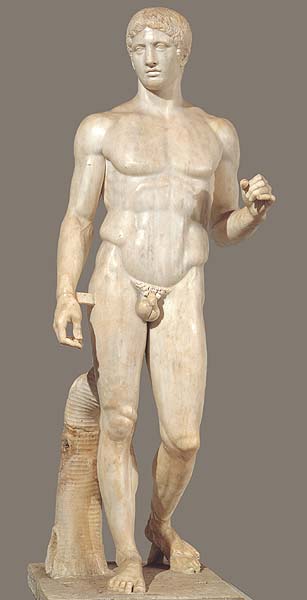
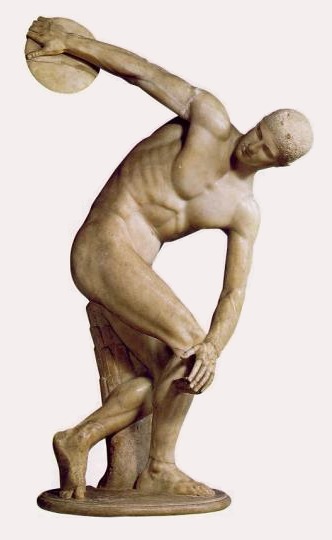
This is a very interesting article about the depiction of the male nude over time and context. The two best points made by the author of this commentary are 1) that the Greeks made the body (particularly the male--in the democratic, yet, un-egalitarian culture) a philosophy; and 2) that the body as depicted by Greeks is primarily intellectual and secondarily sexual; the order switches when personal style is introduced. "Greek athletes are abstract," says the author, Jonathan Jones. This is certainly a compelling point.

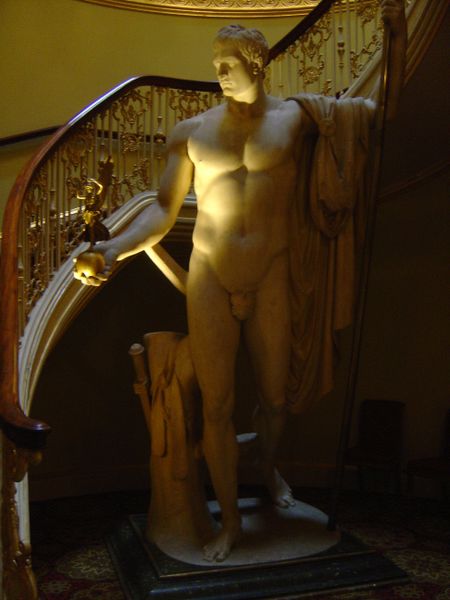
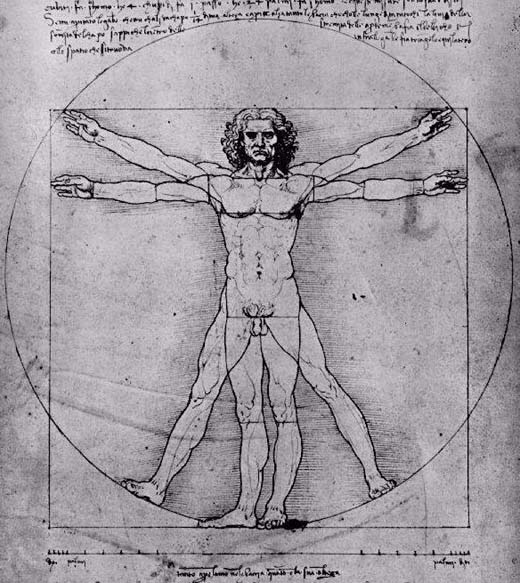
Jones discusses the comedic quality of Canova's statue of Napoleon in the Apsley House--it is both sexual and absurd. Then he takes us through ancient Greece, the Renaissance, the Baroque, and all the way up to modern fashion ads by Calvin Klein and Dolce & Gabbana. Polykleitos's famed canon of male proportions are highly intellectual and abstract; and, even though the character is muscular and nude, sexuality is secondary. Simply by the act of creating a "canon," almost all stylistic sexuality is dissolved. He points how Leonardo da Vinci's "Vitruvian Man" is cosmological and not sexual.

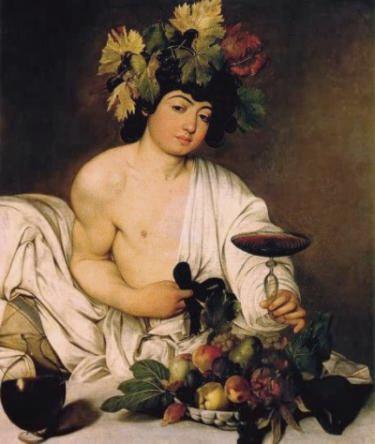
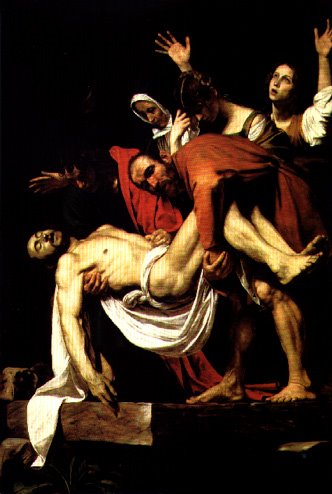
Caravaggio was no idealist. He showed people warts and all, and was not afraid of showing them in an unflattering light (no pun intended). Jones states that Caravaggio's Bacchus is clearly marked with the artist's style, thus sexualizing it. A statuesque figure of a street urchin becomes fleshy and real in form and in context/content and connotatively tactile and sensual. In Caravaggio's Deposition, "the nude has become unheroic, pitiful, and human." Donatello's David reeks with stylized sexuality. "David wears leg armour that sets off his nudity. His buttocks are emphasized. The bronze of an adolescent, hand on hip, huge sword in his hand, is mounted on marble and you walk right around him, painfully aware of the sensuality of the polished metal." Jones also argues that Church's denunciation of nudity during the Renaissance and Baroque periods only made the works more sexual/sensual (forbidden fruit).


The ancient Greek masculine figure was a mathematical and philosophical construction--almost too cerebral to be erotic. The figures were regular, systematic, and abstract with "crisp idealism." What actually confronts the viewer's feelings about sexuality (their own in particular) is an artist's particular style, not the nudity itself. This might not seem like a new idea, but Jones elucidates it in a humorous and intelligent way.

Other images mentioned in Jones's commentary....


Caravaggio, The Victorious Cupid

Myron, The Discus Thrower


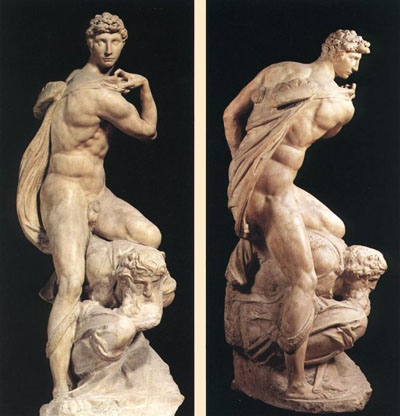
Michelangelo, Victory


© Stephanie Lewis, 2006

Sunday, December 04, 2005

My Favorite Painting of ALL Time

"Judith and Her Maidservant with the Head of Holofernes,"
by Artemesia Gentileschi, oil; 72.5" x 55.75"
(click picture to enlarge)


One of the most common questions I get as an artist/art teacher is "What is your favorite piece of art of all time?" You'd think that this would be a very difficult question to answer, but until I change my mind, this painting by Artemesia Gentileschi is the one for me.

First, you have to know the story of Judith. Click here to read an article on her on wikipedia.org. Consider the size of the painting. It is life size. Imagine coming upon this image in the museum and your eye level is just about where Judith's hand that holds the sword is. Can you avoid feeling like you've stumbled onto a homicide in progress with the dramatic lighting and the blood red curtain in the background? Judith holds out her hand as if to tell her maidservant to be quiet or to block the light from revealing her face. There are a series of interlocking compositional diagonals of light and shadow as well as the position of the figures' limbs and drapery that simultaneously imply action and the nervous stability of being frozen where you stand. Holofernes is barely a "participant" in this composition. His lifeless head is all that is left of him and lies parallel to the horizontal bottom edge of the painting. Judith's maidservant is in the process of bagging or covering the man's head before someone catches the women. Both women are determined yet dispassionate.

The picture has a high degree of realism until you look closer. If the tiny flame on the candle is the only source of light, then it is putting out far more light than is actually physically possible. Also, the placement of the candle is confusing. Is it to Judith's right? Or is it in front of her? The placement of her left hand in relation to the candle creates confusing space in which the candle is both beside her and ahead of her, but the light on her hand indicates it should be straight ahead of her. One can only assume the artist used a second source of light based on these facts and the fact that more of a shadow should be cast by Judith onto her maidservant if the candle is the sole source of light. This slight tweak of space and light enhances the tension of the image. With these idiosyncrasies, this image has captured my attention for a long time with its dramatic lighting, its expression of time, and its dramatic subject matter.


© Stephanie Lewis, 2005

Tuesday, November 08, 2005

Jim Torok

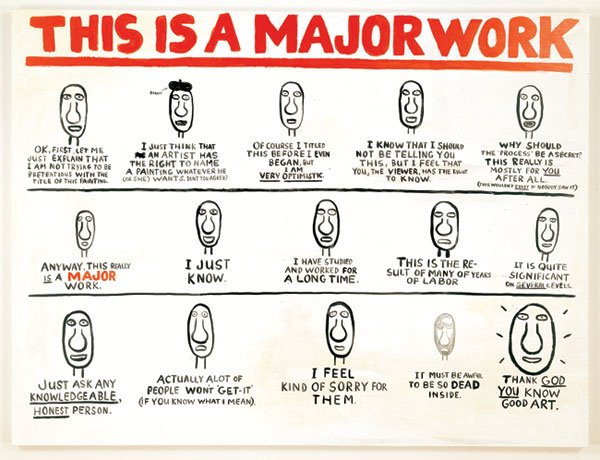
Here is a funny image by Jim Torok that I discovered in this month's Art in America.


You can read about him here.


Monday, November 07, 2005

Dreams, Nightmares, and Memories


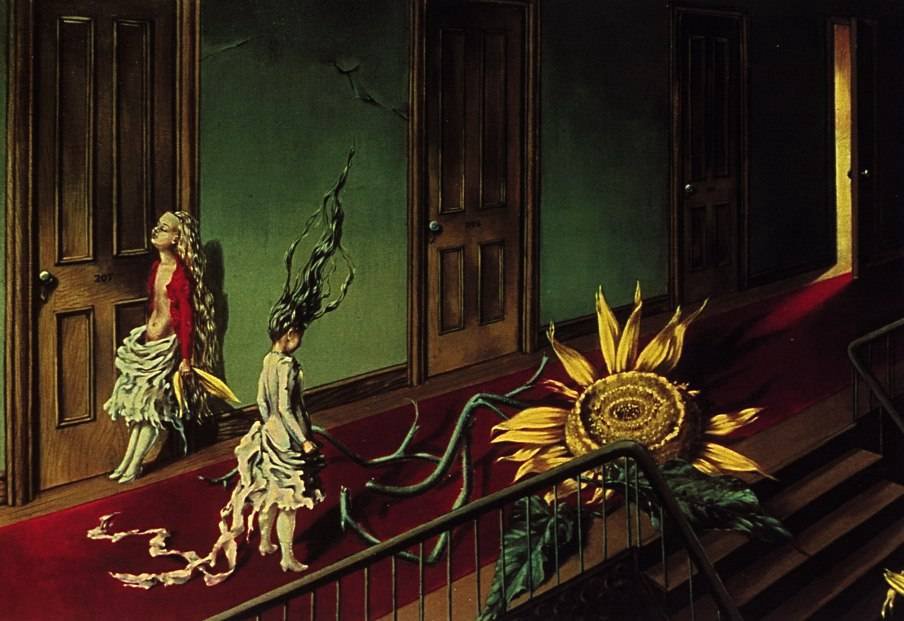
My advanced painting class is working on their fourth painting: "paint a dream or a memory." The assignment also includes nightmares, "out of body experiences," hallucinations, and other levels of "consciousness (or "unconsciousness," as it were)." These things are nebulous things to capture in the mind, much less in paint. One of my favorite dream/nightmare images is Dorothea Tanning's "A Little Night Music."


This work has always captivated me. I believe GOOD art asks questions of the viewer and doesn't merely provide the answers or is "eye candy." I think GOOD art is a seduction of sorts. This painting has a series of strange juxtapositions that make it quite compelling: the child, partially clad, leaning against the doorway; another, with her back turned to the viewer--her hair is flying straight into the air; the giant sunflower in the red-carpeted hallway that leads the viewer's eye directly to another room with the door propped open and a mysterious light emitting from the opening; and stairs that run off the format with a dominant, activating diagonal running through the center of the composition. It's quite a disorienting image. It could be a dream, a memory, a salacious nightmare, or an allegory of puberty. What makes this image so compelling and such GOOD ar,t is that its possible meanings exist on so many different levels.

Read a summary of the piece at the Tate and check out other work by Dorothea Tanning.

Sunday, November 06, 2005

R.C. Gorman 1931-2005

Andy Warhol portrait of R.C. Gorman


About 11 years ago, I worked for a frame store that also sold numbered fine art prints. That year, R.C. Gorman was very big. I could see the decorative appeal of the work, but I didn't know much about him as a person or an artist. His nickname was "The Picasso of American Indian Art." I'm not sure what that nickname is referring to-- his style of art or his prolific art-making. He died Thursday, November 3.