Showing posts with label photography. Show all posts

Saturday, March 29, 2008

Who Says There's No Gender Programming?

Recently, I had the pleasure of judging the PhotoLucida Critical Mass photography competition for the fourth year in a row. I was notified yesterday that there are six finalists and they are asking for proposals from each to choose two top award winners. The award is having their work published.

Here are the remaining six. See what you think:

Beth Dow
Bill Sullivan

Jeong Mee Yoon
Joni Sternbach

Krista Steinke

Peter van Agtmael


If I could cast my vote for one of the finalists, it would be Jeong Mee Yoon. Her statement about life is intelligent, she reveals something about the reality of being human, and reveals the dark and insidious underbelly of gender-programming and our commodity culture. Here is her process:

"To make "The Pink and Blue Project" images, I visit the child's room, where I display and rearrange his/her colored accessories. I ask my models to pose for me with their pink or blue objects, in an effort to show the viewer the extent to which children and their parents, knowingly or unknowingly, are influenced by advertising and popular culture. I first lay out the larger items, blankets or coats, and then spread smaller articles on top of the clothes. This method references objects that are displayed in a museum collection. In some pictures, the children even look like dolls.

I use a 6x6 format Hasselblad camera because the square format enhances the effect of the many crowded objects on display. My photographs are taken with the smallest aperture, f-22, to get a hyper-realistic depiction of each object and person." (1)

Source for photos

I grew up as a tomboy. I liked what boys liked doing and played with boy toys. I always felt like there was a lot of pressure to not be myself. Jeong Mee Yoon's work validates my experience and now I know for sure there is a hell of a lot of pressure on children these days and it is reinforced through commodity culture. Thanks Jeong Mee.

(1) http://www.artinfo.com/news/story/19436/svas-jeongmee-yoon/


Thursday, July 19, 2007

Chilly Portraits

Matt Hoyle exhibits his photographic portraits at the Point of View Art Gallery in an exhibition called Icebergs.


Monday, July 16, 2007

Annie Leibovitz and The Queen

Recently, the Queen of England was presented as blowing a gasket when photographer Annie Leibovitz asked her to dress down for her photo shoot. Of course, the BBC has apologized for misrepresenting the non-event. Here's one reporter's take on the incident prior to the BBC apology:


A traditional portrait of the Queen by Annie Leibovitz.


The BBC Apology


Wednesday, May 09, 2007

Download Gilbert and George's Artwork
by 5:30 p.m. Tomorrow (CST)

Here is the article.


Go here to download.


The artwork is a nine panel piece that you can print off of A4 size sheets and assemble yourself. Here is what you will get....


Planed

There is more on Gilbert & George here. Also, click here to read an article on G & G by renowned feminist Germaine Greer.

Saturday, April 07, 2007

ART CLASSIC #4

This art classic is a series of classics. Sometimes an entire body of work by an artist is poignant. This is especially true of the photographs of the child labor force by Lewis Hine during the early twentieth century in America.*

Biography of Lewis Hine.

It is a difficult thing to create art about subject matter that is tragic. The artist has to walk a thin line between expressing the subject in its pure state and avoiding the pitfall of aestheticizing that subject. Lewis Hine's photographs of the child labor force show an unflinching eye trained on one of the dominant social issues and tragedies in America during the early twentieth century.

Mill Girl

From our 21st century standpoint, the conditions in which these children worked were appalling, and it is still shocking to see children working in factories. We are also aware that child labor is still being used in underdeveloped and third world nations today. Lewis Hine doesn't just capture the conditions. He captures the broken spirit of the children. They appear tired and jaded due to sometimes as many as 10-hour work days. Their clothing, hands, and faces are dirty and they have bags under their eyes. They work barefoot around dangerous machinery and work in coal mines and mills.

Hine's photographs also serve as a stark reminder of class differences. These children worked because they HAD to. Middle and upper class children were NOT working. If a child's father was injured on the job (which was often the case), children often had to go to work to support their families. Many were poor immigrants or disenfranchised farmers who moved to urban areas and had to work for a "boss" for the first time in their family's history.

Breaker Boys, 1910

Aesthetically speaking, Lewis Hine is making documentary photography, but he creates portraits of ghosts to the contemporary eye because these visages still haunt us. They were portraits of ghosts at the time because the subjects' childhoods had died. They haunt us still because, although we are only marginally aware of the use of child labor today (due to a lack of coverage in the media), we are nonetheless aware. Here is a link to an article by Human Rights Watch.


Breaker Boys, Pittston PA, January 16, 1911


Some actually support the use of child labor, if one can believe it. They often state that children have always been a part of the labor force, whether industrial or agrarian, and should still be used. They always add: 'as long as the conditions are safe.' I would argue that there is no such thing as safe conditions in factory work when it concerns children. When children worked with their families on farms, they worked with people who cared for them in close proximity, and only allowed them to do work their bodies were suited for--as they grew older, they obviously did more. Lewis Hine's photographs show us children that are being "used up." The industry or corporation had no and still has no vested interest in providing safe conditions for child labor because 1) the children don't belong to them, and therefore, they have no emotional connection to them--especially if they think having child labor is okay in the first place; and 2) safety regulations and limitations negatively affect their bottom line, which is the primary concern of any business.


While no sane person would advocate child labor, Lewis Hine's photographs make us question the nature of childhood--especially through our contemporary lens. We see faces like these today in the United States and other developed nations. They appear just as jaded and tired but have not worked in factories. Some are steeped in poverty. Some have been abused. Some haven't had their bodies worked, but have had their minds worked to exhaustion. There is more to learn than ever and even more to forget. They are bombarded with information so they can pass "tests." They watch hours of television that gets less intelligent with every passing second. They witness fantasy violence in television and video games to an unprecedented level. They come from broken homes. Perhaps we are more aware than ever of the dream versus the reality of childhood.

Is this childhood?


The Pied Piper by Kate Greenaway


Is this?

Unidentified Victorian Children

Is this?


Sunset by Norman Rockwell

Is this?

Television's The Brady Bunch


Are the images immediately above representations of our fantasy of childhood or are they representations of childhoods only available to a few or in manners of degree in all childhoods? If they are fantasies, why do we create them? Why do we seek to distinguish childhood from other phases of life and represent it in arcadian, idealistic, innocent, and idyllic terms and images? Perhaps some have access to these ideal childhoods, but it seems far more do not. Is Jack Nicholson right in As Good as it Gets? (I apologize for the sound quality):


I believe an "Art Classic" gives the viewer something to chew on or ponder, confronts our values and beliefs, and "wakes us up" to something--be it beauty, tragedy, joy, horror, or the sublime (among others). Lewis Hine's photographs are art classics because he captures a phase in history and the character of the people portrayed, exposes us to our guilt and complicity in the use of child labor, or the purchasing of goods made through child labor, illuminates class differences, reveals childhood as it often and sadly is, and reminds us of what business/corporations/industries are capable of if given free reign and no regulations.


Coupling Boy and
Rhodes Manufacturing Co., Spinner


* Here is a rather extensive digital collection of Lewis Hine's child labor photographs.

© Stephanie Lewis, 2007

Wednesday, March 21, 2007

My Visit to St. Louis

I went to St. Louis the St. Patrick's Day weekend to visit my new nephew, Andrew Clark Fattic. My cousin Amy and Aunt Darlene came up from Poplar Bluff, Missouri to do the same. Here are some pictures from the weekend:


Cool Slideshows

Friday, March 09, 2007

Some Photographers of Note

I've been a reviewer of a photography contest for the last three years. It's called Critical Mass. It's organized by an organization called Photolucida. I just finished reviewing the contestants today and thought I'd share some of the photographers I found to be particularly talented and intriguing in vision:

Jessica Bruah
David G. Burdeny
Tom Chambers
Polly Chandler
James Gritz
Ruth Kaplan
Doug Landreth
Nate Larson
Bill O'Donnell
Darcy Padilla
Susana Maria Cerdeira Paiva
Larry W. Schwarm
Camille Seaman
Gordon Stettinius
Debra Tomaszewski
Shoshannah White
Edward Yanowitz

Thursday, December 21, 2006

Obit: Ruth Bernhard

Click picture for article.

Classic Torso with Hands. 1952
Gelatin Silver Print

Wednesday, December 20, 2006

Exhibition Highly Recommended


The exhibit of Eudora Welty's photographs at the Walton Arts Center is exquisite. Check it out.

On display from December 4, 2006 to February 17, 2007.

Wednesday, June 28, 2006

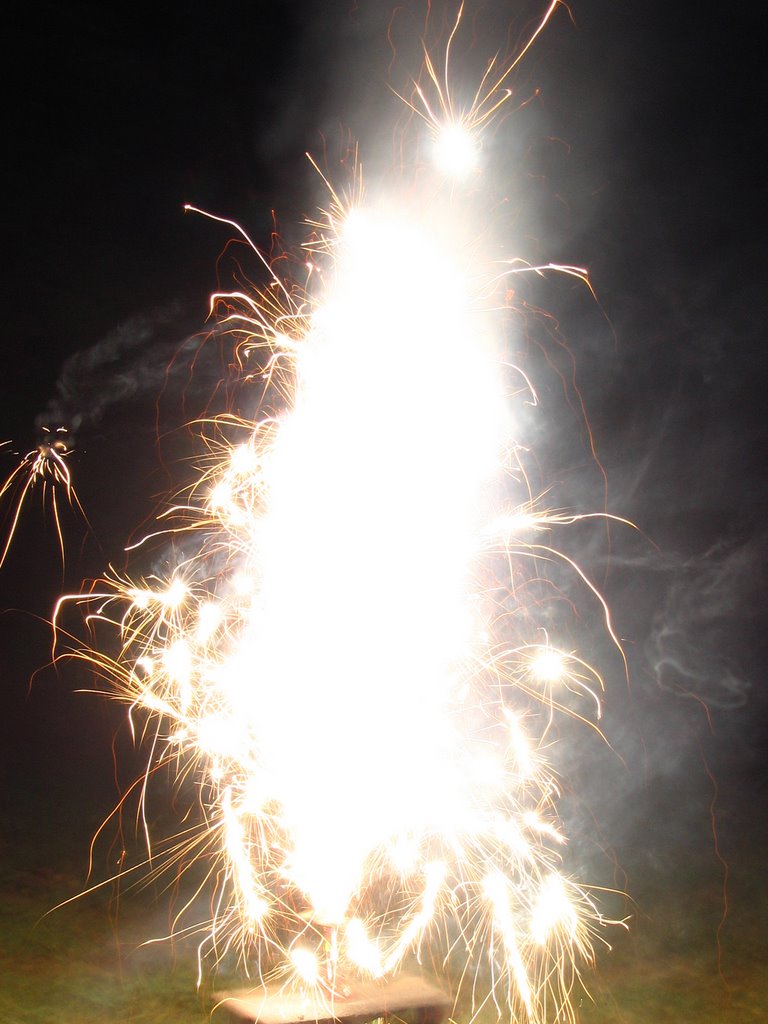
Fireworks as Art

We kicked off the season at home with some fireworks tonight. Here they are with commentary. Click on the images for larger views.

I especially like the warm, orange glow at the bottom and little tracers coming off the spark.


The red streamers are nice in this one.


Again, the red streamers are good, but also the strange glow of the cinderblock in the firelight.


The prickly light at the top of this firework is beautiful.


This one was just blazing!


This one went up in the air and I caught the trail in my camera. It's strangly feathery.


I caught this one during its white-hot phase.


I actually got some color in this shot.


This one looks like the end of a blowtorch.


Crazy colored hairy spider legs.


I think this is my favorite shot, because I caught the fiery launch AND the puffs of smoke.


Whenever I look at fireworks, I think of James Whistler's Nocturne in Black and Gold: The Falling Rocket
(1875). It is considered to be one of the first steps toward pure abstraction. It is often compared to Turner's landscapes and is considered the beginning of Whistler's influence on modern art....


Sunday, November 27, 2005

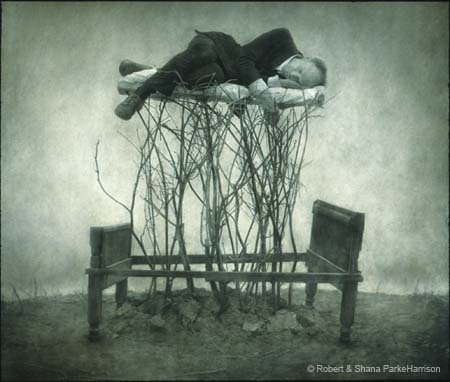
Robert & Shana Parke-Harrison

I watched a program called Art Close Up on AETN tonight. The program featured a photographic couple named Robert & Shana Parke Harrison. He and his wife Shana actually work as a team when producing the work. She acts as a director and they both work on the concept and execution together. They work in a staged photographic format rather than a candid format, and though I am less of a fan of staged photography, I find this work to be quite beautiful and poetic. The program presented an art critic who described the work as representations of the "every man" and his struggles. I'm not sure this assessment quite encapsulates the broadness of interpretive possibilities but it is a good start. There are also statements about mankind's relationship to the environment within the photographs. The program was particularly insightful because it revealed their process(es) which they apparently have kept guarded for some time. If you're a photographer intrigued by layering and collage, staging, and process in general, this couple of artists are the ones for you.

It's hard to pick a favorite one from the site,
but this piece called "Forest Bed," comes pretty close for me.