Farrah Fawcett died last week and was buried Tuesday. Most articles have focused on her obvious sex appeal, but Farrah and the other Angels as well as Lynda Carter in Wonder Woman and Lindsay Wagner in TheBionic Woman were very formative role models as a girl in the seventies without liberated parents. Farrah was the face of the Angels, a group of smart, liberated, and powerful women who solved crime and put bad guys in jail. They and the other two I mentioned gave me a belief that women could in fact, do anything that men can do. I realize it was cheesy television, but to a six or seven year-old it wasn't. Farrah also went on to act in films like the TV movies Double Exposure: The Story ofMargaret Bourke-White, The Burning Bed, Nazi Hunter: The Beate Klarsfeld Story, and Extremities. Margaret Bourke-White was an adventurous female photographer in the 30s and 40s who took the famous photo of the men at the fence at the liberation of Buchenwald. In The Burning Bed, she fixes her abusive husband's wagon by burning down the house with him in it. In Nazi Hunter, she "plays real-life Beate Klarsfeld, a German Protestant housewife who, with the help of her Jewish law-student husband, Serge, began an unrelenting campaign after World War II to bring Nazi war criminals to justice, most of which is centered on Klaus Barbie." (1) And in Extremities, she turns the tables on her would-be rapist. No other Angel consistently chose powerful women as her characters of choice. In a world of Lifetime TV (as I call it, Victim Television) that romanticizes women in their socialized victim role, she raised the bar for female empowerment and her characters refused to be victims.
One thing the reader may not know about Farrah is that she was an artist. (2) In 1999 she paired up with another artist, Keith Edmier, to embark on a very postmodern, post-Warhol project. (3)(4) She acted as his "muse" and he hers, and they made nude sculptures of one another. Her figure was in marble and his in bronze. The talent Farrah possessed in the handling of the material and in expressing her vision is undeniable.
Farrah working on her sculpture of Edmier.
Farrah Fawcett's sculpture of Keith Edmier
Detail of the sculpture of Edmier
She possessed enough talent to be recognized as an artist in an exhibit with Keith Edmier at the Andy Warhol Museum. (5)
Of course, what she is remembered for in the media and our pop culture world is her 70s bra-less-ness, her much-copied hairdo, and famous poster donning the childhood walls of men in their late 30s and early 40s today. She is a study in contrasts in our image-obsessed culture. Even today, after the age of women's liberation in which she burst into her fame, women are still noticed for their appearance, not for what they do or produce. Farrah Fawcett is remembered for her "Jiggle TV" role in Charlie's Angels, but not for the characteristics of the role of Jill Munroe. Fawcett's character in the show was a tough, karate-chopping gumshoe who was the most athletic, as well as giving back her time to coach a girl's basketball team during the early years of Title IX. (6)
Farrah is also remembered for playing "victims" in highly charged TV dramas--or at least, that's what the media would have you believe. The Burning Bed put Farrah back on the map in terms of notoriety. But, during the last week, clips from the film have been shown on various news outlets showing a bedraggled, worn-down, beaten and battered wife, not the woman who lit the match. Likewise, the clips shown from Extremities, (7) show a woman being overwhelmed by a would-be rapist, when the point of the film is that she captures and tortures him--particularly HIS extremity. This observation is also true of an image search for film stills on the internet. 99.9% of the images show a different picture of these two films' plots. What constitutes good acting for a woman is playing a character who is victimized, not triumphant or focused on strength, adventure, and justice.
It's not very often that art actually has a measurable impact on life. A lot of attention was brought to the issues of domestic violence and rape due to Farrah's famous roles in the 1980s. The Burning Bed won top ratings in 1984, obviously demonstrating a resonance with society. (8)
I was very sad about Farrah's death this last week, not only because she was one of a few pivotal role models from my childhood TV viewing, but that she is being remembered for only the superficial things. It is typically American to celebrate form over substance. But, Farrah was a substantial individual even to the end of her life. The last part of her substance she decided to share with us was her battle with cancer. The documentary, Farrah's Story documented her struggles with the disease and its treatment, touching many people's lives in a REAL way. It is my hope that some day, when and if we become more enlightened and grown-up as a culture, that she will be remembered for this, giving young girls the dream of competency and capability, empowering women, and her personal artwork. Even if the culture never does, it is how I will remember her.
"myspace" Installation (1) on the University of Arkansas Union Courtyard March 14 - April 5, 2008 by Kelsey Felthousen
Yesterday, I was driving to work and thinking about Americans' notions about privacy--how we put it all out there on myspace, Facebook, or even here on Blogger, etc. We're acclimated to talk shows where people spill their guts about extraordinarily personal things on television transmitted out to millions of strangers, not to mention "reality shows" that have been added to that mix as well. We're so comfortable or have been made to feel so comfortable at exposing ourselves, there's barely a peep from the culture in reaction to our government's surveillance of its own citizens.
Perhaps it was kismet, but after my morning drive, I arrived at my office where a colleague* had left a newspaper article (2) about Kelsey Felthousen's Master's Thesis Exhibition at the University of Arkansas. Kelsey describes her project as
“(dealing) with the notions of an overexposed, vulnerable society that…feels unprotected. When creating this work I chose to broach the subject of sacred/private space and how that space is being given away freely, without thought of the consequences.”
“Sacred Space, as defined in this exhibition, is the preciousness of close relationships and the privacy within our lives and homes. One need not search far for evidence of this exposure. It can be seen in all aspects of our society, from television programming to technology.” (3)
Of course, after my morning musings and reading the article, I HAD to go see the installation. It's imperative to see an art installation in person because they are time-limited and are meant to be experienced physically.
Typically, I write my "Art Classics" about works from relatively near and distant art history. But, I think I'll preempt art history on this one and say this is an instant Art Classic and will probably be so in the future.
Images from Kelsey Felthousen's Exhibition
First, it is a privilege and a pleasure to view such a cutting-edge, intellectually-stimulating, and culturally relevant work of contemporary art. It is an oasis in the desert that is the dearth of such works in Northwest Arkansas.
Kelsey Felthousen (right)
What I respond to most are the layers of experience embodied in the work. First, it is both installation and performance art (4). Installation is already part sculpture, so one could say there are three immediate layers perceived. The piece is constructed of a central area that is a wood-framed square with the siding for the "house" on the inside. There is a door to enter the "garden" on this "inside" area where there is no roof. Tulips and pansies comprise the garden. The "rooms" of the "house" are outside this square exposed to the elements splayed out on the four sides on various floor substrates in a cloverleaf pattern. The rooms are comprised of variously familiar and comfortable furnishings and knick-knacks that make a "house" a "home." But this "home" is decidedly uncomfortable and vulnerable. It's as if Jeff Goldblum sent a normal house through his infamous teleporting machine and once again, point B came out as something quite unexpected.
The piece is present and massive like sculpture but open to the point of encouraging almost socially inappropriate interaction. There's a natural hesitancy in most people when it comes to entering strangers' homes, but this stranger has opened her house and the exhibition goers react accordingly. On the evening of the reception on March 28, snacks were placed in the "kitchen" and "living room" of this "house". One could see the body language of exhibition goers quickly transform to extremely casual mode. They sat on the furniture, ate her food, looked through her cabinets, used her microwave, entered her garden, and used her barbeque pit to cook. Social boundaries had clearly broken down in a matter of seconds.
My favorite view of the installation is the view through the kitchen window. As with many homes, you expect to see a garden and you do. However, this garden is enclosed and the area is in shade. The siding of the "house" can bee seen from that window as well, creating cognitive dissonance. At once, the viewer thinks that he or she is looking into a room and into a garden outside. There is no roof to this room and it is not really a garden. It is theater, theater in which one has no real inkling of the character or identity of the "actor" -- sort of like myspace®. (5) Typically, houses represent the self as symbols. This fact has been true historically in art, literature, psychology, and even religion. (6) People in normal houses keep the inside enclosed and private, and decorate the outside of their houses to create a veneer of normalcy to the outside world. In the case of this installation, the garden is protected and the resident's private effects are exposed to inspection and scrutiny. It's not until one enters the garden and stands inside that one realizes that the private self is no better protected as there is no roof. Privacy has become an illusion. The self as represented by the house becomes an illusion, a theatrical performance, and a dance between vulnerability and invulnerability; and indeed, a dance with the devil, and as compelling as any Magritte (7) painting.
View of the gallery part of the installation
As I said earlier, there are many layers of experience to this installation. The second layer takes place in the Fine Arts Gallery inside the Fine Arts Building. There is another living area set up in the empty gallery facing what appears to be a television but is a giant computer monitor broadcasting the University of Arkansas Central Quad webcam that is trained on Kelsey's installation. Visitors eat snacks off of a coffee table and can sit at a desk or sit on a couch or chair and view the installation in real time on the large screen. The self thereby becomes a spectacle, and the viewers in the gallery, voyeurs. We have been acclimated to this role for quite some time since the advent of television. "Reality" television makes us even more comfortable with our inner voyeurs. At least some sort of relationship between the artist and the viewing public is encouraged at the physical site of the installation, but this is lost through the physical and digital distancing of the computer monitor. It was not as astounding to see individuals in the gallery as comfortable with boundary-breaking as the visitors to the physical site were because we are so familiar with this scene.
In yet another layer, one realizes from watching the monitor in the gallery, that the webcam is also seen by anyone who encounters it. Also, in a more disturbing twist, the University webcam is fully controllable by those people. So, as one watches the monitor, one is watching a watcher who is a stranger. This stranger may just center the installation and watch it from a distance, they may zoom in on her "bedroom", or they may even focus the webcam on an individual as they walk by and "follow" them while they are doing so. The webcam is not fixed or controlled by one director but is essentially a production of many strangers who are essentially as voyeuristic as the people in the gallery. The irony is this aspect of watching the watchers--essentially making us all spectacles. And that seems to be the nature of modern life--so many people have abdicated their privacy and made themselves spectacles that we all become part of the "show."
The performance art aspect of this show is the fact that Kelsey lives in her installation--submitting herself to the intrusions and glances. A lot of individuals do this in day to day life with little thought to the consequences. She therefore becomes exposed to the elements and what would normally be unwanted behaviors and gestures.
I said earlier that myspace was intellectually-stimulating and culturally-relevant. To me, these are two very important qualities to qualify a work as an art classic. The layers of complexity and even humor make this piece intellectually-stimulating. It is a very difficult thing for an artist to hit the sweet spot in terms of timing in a culture, and Kelsey does it with smarts and gusto. She reveals something about us as human beings in the here and now as a world moves from a culture that sees to one that is seen and dare I say, with a dash of beauty, my other criteria for an art classic. I am going to watch her career and would encourage others to do so. This is not the last we'll see of Kelsey Felthousen.
* Special thanks to Eric Smith who gave me the article on Kelsey yesterday. Eric and I have been on the same creative wavelength for 13 years now and he is a wealth of information that I cherish.
(1)http://www.artlex.com (2) http://www.nwarktimes.com/nwat/News/63540 (3)http://art.uark.edu/fineartsgallery/?p=45 ; Kelsey says that two of her big influences are Ann Hamilton and Vito Acconci. (4) "Art in which works in any of a variety of media are executed premeditated before a live audience. Although this might appear to be theater, theatrical performances present illusions of events, while performance art presents actual events as art. One of the things setting postmodernism apart from modernism is its acceptance of aspects of theater. Performance elements surfaced in a number of conceptual art movements of the 1960s, including: Fluxus, Happenings, body art, process art, street works, etc. The 1980s saw the emergence of performance artists like David Byrne (American) and Laurie Anderson (American, 1947-), who had each been students of visual art, but whose work gradually incorporated voice, music, costumes, projected image, stage lighting, etc. " (http://www.artlex.com ; definition of "performance art") (5)http://www.myspace.com (6) In psychology, there is a projective test in which patients are asked to draw a house, a tree, and a person. Once analyzed, these images will reveal personal information about the patient. For instance, drawing a pronounced knothole in a tree often reflects trauma. If the windows of the house are missing or covered, there is an issue with boundaries and privacy. In religion--Christianity for example-- Jesus compares the spiritual self to a house on rock or a house on sand, and that is one of many religious examples across religions. (7)http://www.magritte.com/
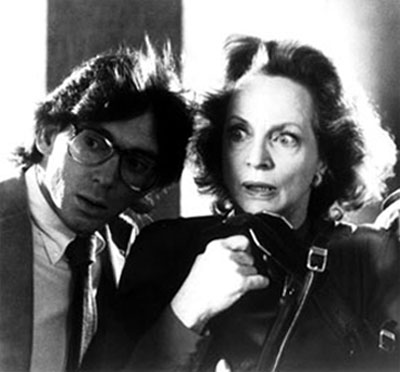
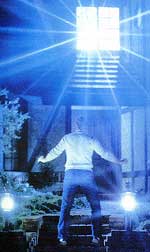
Director: Tobe Hooper(The Texas Chainsaw Massacre) Writer: Steven Spielberg (story) Screenplay: Steven Spielberg, Michael Grais, and Mark Victor Special Effects: Industrial Lights and Magic (Lucas) Producers: Kathleen Kennedy, Frank Marshall, and Steven Spielberg Musical Score: Jerry Goldsmith [1] (Oscar, Best Musical Score, The Omen) [2]
This year is the 25th anniversary of the film. One reason Poltergeist is so perfect is because of the people involved in the production: Tobe Hooper, Steven Spielberg, Jerry Goldsmith, and George Lucas' Industrial Lights and Magic. The list reads like a who's who of classic and expert film production. How could it not be perfect with this ensemble?
Many horror films have been made in over a hundred years of film making and certainly, most are a dime a dozen. There are many genres of horror films: the slasher films, creature features, 'B' horror, to name a few. Nearly all of the genres seem apt to become dated as they are often reflective of a specific period in cultural time and tossed on the winds of fad culture. Only one genre stands the test of time, no matter how old the story or film becomes: The Ghost Story. The cast of creators aside, what makes Poltergeist so perfect is the story. What makes the film so unusual as a horror film is that it does have great writing. But this is no usual Ghost Story. The Ghost Story is merely the vehicle for the larger message (which horror films almost never possess).
Poltergeist uses all the typical devices of a classic Ghost Story horror film: creaking sounds, subtle voices, play on light and dark, simulated heartbeat sounds, things emerging from the periphery, cropping, surprise, terror juxtaposed with ordinary objects, people, etc. Spielberg, et al. take the right approach with fear, which is, that it is simple and not complicated, and doesn't require a lot of gore. It is this sparseness and simplicity and earnestness of acting by a then unknown cast of characters that makes the film so terrifying. I saw this film when I was eleven years old. I watched it at a friend's house on cable. It was scandalously uncut and it terrified the living daylights out of me. It was the first horror film that really blew me away. However, I was too young to appreciate its broader meaning. It is not only a timeless ghost story but a timeless cultural commentary as well.
The trailer to the film makes the best plot summary:
The film is a classic Ghost Story but it is also about the microcosm of house/home/family that symbolize the country. It's about patriotism and nostalgia, economic downturns, innocence and the loss of it, greed and abundance, form without substance in American culture, and ultimately, the loss of the American Dream.
The Freelings and the American Dream
The family is Steven and Diane Freeling and their children Dana, Robbie, and Carol Anne, and their dog E. Buzz. First, their name is "Free-ling." Much like "underling" or "earthling," it is not so much a name as a designation.
These "free" people live in a suburban home in a development called Cuesta Verde (loosely translated = "it costs green"). It is a manufactured neighborhood of suburban sprawl where all of the homes look the same, which is a quality that recalls Malvina Reynolds' song, "Little Boxes." [3] The family's life reads like a commercial for middle class abundance: the perfect house, 2.5 kids, toys and other products filling the house, etc. Douglas Kellner states, "By depicting with affection its residents, houses, goods, toys, and electronics, it presents advertisements for a U.S. way of life which defines happiness in terms of middle-class lifestyle and consumption." [4] Kellner calls Spielberg's films "clever ideological fables" and "meticulously constructed ideology machines." [5] He states, "The film attempts to manipulate its audience through carefully planned, carefully paced jolts, special effects, frightening scenes, sentimental depictions of a loving family, and the assuring presence of technology, professionals, and spiritual powers. " [6]
Kellner's observations are poignant and astute. I personally think the term "sentimental" as applied to the depictions of the Freelings as a loving family would be better termed "idealized." In the film, the family is shown as a tight unit that only begins to break up under the assault ofthe poltergeist intrusion. They share a bed, they joke and play with one another, and even when they embark on the rescue of Carol Anne, they show courage and a tight bond. When deciding who should enter the closet/portal to rescue the child, Diane convinces Tangina (the spiritualist) that she should go since she is Carol Anne's mother. Steven says that he should go instead. Diane says, "Who's strong enough to stay up here and hold the rope?" He relents and as she starts walking into the closet, she turns andshouts to Steven, "Steven, don't let go!" Diane goes into the unknown and Steven "tows the line." The image of the Freelings is idealized and heroic. They face their fears to save their daughter--head on. And this is no difficult task, because the supernatural force that they are fighting knows their fears and exploits them.
The theme of the American Dream is further reinforced by elements in the film. First, the film opens with a very blatant use of the Star-Spangled Banner being played at the end of day broadcast of a network channel on television. Steve Freeling has fallen asleep in his chair in front of the television as the broadcast day winds down in this iconic way. I don't think it's unintentional on Steven Spielberg's part. Opening the film in this way is a tight piece of foreshadowing as well as a symbolic representation of the American Dream coming to an end: in this case, reverting to the low power "snow" mode of the television channel. It is also a genius creative choice in terms of the musical score. This scene is shown not once, but twice--the second time being as the whole family (except the teenage daughter) are asleep in the parents' bed and right before the poltergeist makes contact with Carol Anne and causes an earthquake (only in the Freelings home, interestingly enough). Johannes Grenzfurthner states, "It is no coincidence that in the film “Poltergeist” from the early 80s Tobe Hooper used just this phenomenon as something calculated to give one the creeps. After the American national anthem the broadcast is over; the snowstorm sets in. And it doesn’t take long for the eerie voices of the damned to start calling out of the hypnotic blizzard. It seems as if we would like to ban this snow from our world."[7] As Kellner stated, happiness is defined "in terms of middle-class lifestyle and consumption." The American Dream to Spielberg and Hooper is about the acquisition of a home, updated technology, a swimming pool, 2.5 children, and an abundant collection of (Lucas-based) toys for those children. The teenage daughter even has her own phone in her room. This is the age of innocence and abundance for the Freelings. The musical score by Jerry Goldsmith reinforces this period of the film by scoring it initially with what is basically a lullaby. Gradually, as the Freelings' lives go out of control, the score alternates with darker and moodier tones with intense, bombastic music.
Besides the use of the Star-Spangled Banner, economics (and politics) are alluded to in another subtle way. Near the beginning of the film, Steve Freeling is laying on his stomach on their bed while Diane is rolling joints. He is reading a book entitled Reagan: The Man, The President. [8]Reagan would later become the President who posited "Trickle-down Economics" which is also known as Reaganomics or Supply-side Economics. "Proponents of these policies claim that they will promote new investment and economic growth, thereby indirectly benefiting people in lower tax brackets who do not receive the direct benefits of lower taxes. Opponents characterize this as a claim that the people who would otherwise pay the tax will distribute their benefit to less wealthy individuals, so that a fraction will reach the general population and stimulate the economy." [9] In addition, even though the modern War on Drugs was started by President Nixon in 1969, it was Reagan who created the Office of National Drug Control Policy in 1988. So, the irony is not lost on the contemporary viewer when watching Diane prepare marijuana for their mutual consumption while Steve is reading a book on Reagan. There was also a real life economic contradiction going on during the age of Reaganomics. While the economy was being presented as good, the reality was that it wasn't. Mortgage interest rates only dropped below 10% once during the Reagan Presidency (1987) . During the year that Poltergeist takes place, the mortgage interest rate was 14.72/14.74% (fixed/adjustable). [10]So, buying a home was out of reach for most low income wage earners--unless they were willing to sacrifice their family on the altar of work to "keep up with the Joneses." Viewers of the film know that Steve Freeling is upper middle class because his boss, Mr. Teague, offers him a brand new home at no cost to keep him employed because Steve is singlehandedly responsible for bringing the company over $70 million in real estate sales. However, pitted against this wealth and idealistic family harmony is the isolation of the nuclear family, the forces of nature, failed technology, and the mesmerism of television. We also eventually find out that the initial cause for all the disturbances in the Freelings' house is GREED. Mr. Teague, knowingly, and probably in cahoots with other questionable characters, decided to cut corners and increase profits by only moving the headstones of the cemetery on which the Freelings' house rests.
The Tuthills
The Tuthills are the Freelings' next door neighbors. They have achieved the same measure of success as the Freelings although they are presented as less sophisticated (e.g. the son is portrayed as a slack-jawed child). Mr. Tuthill is competitive with Steve and it is obvious that neither wants a "neighborly" relationship with the other. The competition is expressed through the television remote fight that they have when both are apparently on the same frequency and Mr. Tuthill's children would like to watch Mr. Rogers and Steve would like to watch football with his buddies. The scene is one of the most humorous but also the clearest representation of their competitive relationship. The men have achieved everything (presumably), yet assert their power in this childish way. The Tuthills are not only competitive, they are oblivious to the travails the Freelings are enduring in their home. None of the disturbances are happening on their property. But even when they are pulling Diane from the skeleton-filled swimming pool, it is unclear whether or not that they notice the bodies at all. They seem to respond only to the screams of the children inside the house. It is not until the house finally implodes that they seem to react to the supernatural events. It is possible, however, that they perceive the imploding of the house to be related to a gas main explosion. Either way, the impression left with the viewer of the film is that the family is in utter isolation in its experiences, even though they are surrounded by suburban sprawl and neighbors that are literally a stone's throw away.
Man Versus Nature
Three forces of nature are pitted against the Freelings. One is the manifesting force that Diane calls "another side of nature" which is the appearance of supernatural events in the home. The other two more tangible forces of nature are the dead tree that springs to life and tries to devour Robbie and the tornado (that is presumed to be a part of the thunderstorm) that whisks the tree away before it has a chance to do so. Robbie shows an early fascination with the dead old tree in the film. He is obsessed with it--terrified by it. It sparks his imagination and disturbs his sleep. Initially, it seems out of place in the new and shiny opulence of the suburban landscape. It seemed to be carefully left there to "add character." In the end, it becomes the fly in the ointment for the Freelings. Not only does it try to devour Robbie, it acts as what appears to be a deliberate distraction for the supernatural elements to abduct Carol Anne, which they do. The storm and subsequent tornado once again seem to only be happening at the Freelings' home. Historically, The Storm has been a symbolic presence in all the arts to represent the forces of nature that humankind battles against. Everything else in the Freelings' lives up to this point seems to be under control. Nature is not under control and supernatural and natural forces conspire to destroy their dream of American "normalcy."
Technology Run Amok
Another theme of the film is that the comfort that technology brings to the modern life is fleeting and unpredictable. It is the illusion of comfort at best. Shorts and manufacturer's defects happen. Faulty programming happens. Warranties run out. In the Freeling home, light bulbs burn with extreme intensity and don't burn out. They flash, spark, and flicker. Most notably, remote control and electronic toys move on their own and eventually spin around the children's room in a frenzy. The viewer is confronted by an electronic robot in one scene when the paranormal researchers open the door to the children's room. The robot approaches the viewer on its own power, laughing maniacally. At the same time, a lamp flies through the air and "plugs itself in" and turns on. A record is played by a compass point. It is during this frenzy of spinning toys that we are once again reminded of the amount of things the children possess. These things are out of control in this context. Later we are simultaneously reminded of affluence and recalcitrant technology in the form of Robbie's ominous talking clown at the foot of his bed. Eventually, the fear that the poltergeist knows he has comes true and the clown attacks and tries to strangle the boy. The clown's face has become contorted with evil and he also laughs maniacally as he attacks the boy. Robbie is at once strangled by what Whitman called the "mania of owning things" and technology. Fortunately, the ordinarily fearful and timid Robbie finally gains his courage, owns his power, and rips into the wayward toy shouting, "I hate you!" Of course, by now, the viewer has realized that the clown was another distraction to try and abduct Carol Anne a second time.
The most apparent technology in the film is the television. It is the through the television that Carol Anne is first contacted by the poltergeist. It whispers to her and eventually reaches out with a ghostly appendage to touch her. It shoots energy through her prior to the "earthquake" in the Freelings' home. Once abducted, she communicates through it with the family. Ultimately, her communication through the television is unsatisfying and ineffective. One can't have an intimate relationship with a television. Steve Freeling has fallen asleep in front of the television. It is kept running in the background. At one time, the whole family falls asleep in front of the television. There is a television in every room. It is essentially treated like a member of the family. But this "member of the family" has a hidden agenda.
It seeks to seduce the most innocent corporeal member of the family into its realm. One doesn't have to delve too deeply to understand the statement Spielberg and Hooper are trying to convey. There's even a touch of irony after the poltergeist contacts Carol Anne the first time through the television and after she becomes fascinated with the low power station from which the poltergeist's communications come. The scene takes place during breakfast on Monday morning. Carol Anne is too young to go to school. Once the other two children start heading off to school, Carol Anne heads over to the small television in the kitchen, climbs up on a stool and switches the channel to the snow channel to see if she can hear the voices again. Diane passes Carol Anne as she's cleaning up the breakfast table and declares, "Oh honey, I wish you wouldn't stare at that channel. You'll hurt your eyes." As Diane utters these words, she simultaneously changes the channel to a violent war film. Again, the irony is deliberate and not lost on the viewer. One will hurt the child's eyes. The other will hurt the child's mind (as many believe, though this is not necessarily agreed upon by experts). Of course, we know today that Spielberg personally believes this because he took the extra effort in the re-release of E.T. to digitally remove the guns out of the federal agents' hands at the end and replace them with walkie talkies--because he believed that ultimately, it was too violent an image for a children's film.
Those Who Don't Study History....
...are condemned to repeat it. We've all heard the adage. The Freelings also express 1) The lack of knowledge of history, and 2) seem to not be capable of learning from their experiences. These two qualities are extremely prevalent in Americans (one could, of course, argue all of humanity). Steven is the top salesperson at the company who built his house and he was not aware of Mr. Teague leaving the bodies and just moving the headstones prior to construction of the subdivision? The family is literally blissfully unaware that their house is on a sea of bodies--some of which are centuries old. Our ancestors are our history. Ghosts symbolize memory and history. When the ghosts are finally captured on film, Diane says, "Look at all of them." Robbie responds, "Where are they all coming from?" This dialogue expresses their obliviousness to the true history of the house.
The Freelings have encountered a poltergeist that tried to drive them out, devour their son, and succeeded at kidnapping their daughter. They are told by Tangina that the other presence inside the house was The Beast, or Lucifer, or Satan, or Beelzebub, or the Lord of the Flies, or whatever you want to call him/it. It is after all this, that they STILL decide to spend one more day (and night) at the house. It seems crazy by any standard. They seem determined to return to the bliss and normalcy that they had before--to their own detriment. Steve goes to work. Diane has the children tuck themselves into the same beds that are in the same room where Steven faced The Beast. While they're tucking themselves in, she goes into the bathroom to dye her hair. The children are left alone to fend for themselves even after the extreme risk Diane took by spelunking via a hemp rope into the supernatural world of the poltergeist and The Beast and exiting through the living room ceiling. The results of this laissez-faire attitude are predictable.
The "Experts"
In Poltergeist, the experts are the three paranormal investigators, and the eccentric spiritualist, Tangina. The paranormal investigators are clearly overwhelmed by the extreme nature of the Freelings' problem. Tangina admits not encountering such energy before. If we see the former as representing "science," and the latter representing "religion," both are poor substitutes for the "real" things and are incapable of rescuing the Freelings from their situation. It is up to the family in a "man versus supernatural" battle, in which only their bond equips them for this battle. Science and Religion can't rescue them from their suburban malaise either.
Conclusion
Poltergeist's perfection lies in its cleverly, yet thinly disguised story of a heroic family's journey. There are all the Joseph Campbell elements in this family's journey (which is really no surprise since Spielberg and Lucas go way back, and Lucas was a student of Campbell's). These heroes participate in battles and individuals are resurrected. Innocence is lost. It has the cautionary nature of an medieval fairy tale set in a modern suburb. It is a not-so-subtle piece of socio-economic and political propaganda. It explores the themes of man versus himself, man versus nature, man versus man, and man versus the supernatural. And of course, it still terrifies movie watchers through its masterfully applied horror creation techniques. It is a "ghost story" to end all ghost stories.
This art classic is a series of classics. Sometimes an entire body of work by an artist is poignant. This is especially true of the photographs of the child labor force by Lewis Hine during the early twentieth century in America.*
It is a difficult thing to create art about subject matter that is tragic. The artist has to walk a thin line between expressing the subject in its pure state and avoiding the pitfall of aestheticizing that subject. Lewis Hine's photographs of the child labor force show an unflinching eye trained on one of the dominant social issues and tragedies in America during the early twentieth century.
Mill Girl
From our 21st century standpoint, the conditions in which these children worked were appalling, and it is still shocking to see children working in factories. We are also aware that child labor is still being used in underdeveloped and third world nations today. Lewis Hine doesn't just capture the conditions. He captures the broken spirit of the children. They appear tired and jaded due to sometimes as many as 10-hour work days. Their clothing, hands, and faces are dirty and they have bags under their eyes. They work barefoot around dangerous machinery and work in coal mines and mills.
Hine's photographs also serve as a stark reminder of class differences. These children worked because they HAD to. Middle and upper class children were NOT working. If a child's father was injured on the job (which was often the case), children often had to go to work to support their families. Many were poor immigrants or disenfranchised farmers who moved to urban areas and had to work for a "boss" for the first time in their family's history.
Breaker Boys, 1910
Aesthetically speaking, Lewis Hine is making documentary photography, but he creates portraits of ghosts to the contemporary eye because these visages still haunt us. They were portraits of ghosts at the time because the subjects' childhoods had died. They haunt us still because, although we are only marginally aware of the use of child labor today (due to a lack of coverage in the media), we are nonetheless aware. Here is a link to an article by Human Rights Watch.
Breaker Boys, Pittston PA, January 16, 1911
Some actually support the use of child labor, if one can believe it. They often state that children have always been a part of the labor force, whether industrial or agrarian, and should still be used. They always add: 'as long as the conditions are safe.' I would argue that there is no such thing as safe conditions in factory work when it concerns children. When children worked with their families on farms, they worked with people who cared for them in close proximity, and only allowed them to do work their bodies were suited for--as they grew older, they obviously did more. Lewis Hine's photographs show us children that are being "used up." The industry or corporation had no and still has no vested interest in providing safe conditions for child labor because 1) the children don't belong to them, and therefore, they have no emotional connection to them--especially if they think having child labor is okay in the first place; and 2) safety regulations and limitations negatively affect their bottom line, which is the primary concern of any business.
While no sane person would advocate child labor, Lewis Hine's photographs make us question the nature of childhood--especially through our contemporary lens. We see faces like these today in the United States and other developed nations. They appear just as jaded and tired but have not worked in factories. Some are steeped in poverty. Some have been abused. Some haven't had their bodies worked, but have had their minds worked to exhaustion. There is more to learn than ever and even more to forget. They are bombarded with information so they can pass "tests." They watch hours of television that gets less intelligent with every passing second. They witness fantasy violence in television and video games to an unprecedented level. They come from broken homes. Perhaps we are more aware than ever of the dream versus the reality of childhood.
Is this childhood?
The Pied Piper by Kate Greenaway
Is this?
Unidentified Victorian Children
Is this?
Sunset by Norman Rockwell
Is this?
Television's The Brady Bunch
Are the images immediately above representations of our fantasy of childhood or are they representations of childhoods only available to a few or in manners of degree in all childhoods? If they are fantasies, why do we create them? Why do we seek to distinguish childhood from other phases of life and represent it in arcadian, idealistic, innocent, and idyllic terms and images? Perhaps some have access to these ideal childhoods, but it seems far more do not. Is Jack Nicholson right in As Good as it Gets? (I apologize for the sound quality):
I believe an "Art Classic" gives the viewer something to chew on or ponder, confronts our values and beliefs, and "wakes us up" to something--be it beauty, tragedy, joy, horror, or the sublime (among others). Lewis Hine's photographs are art classics because he captures a phase in history and the character of the people portrayed, exposes us to our guilt and complicity in the use of child labor, or the purchasing of goods made through child labor, illuminates class differences, reveals childhood as it often and sadly is, and reminds us of what business/corporations/industries are capable of if given free reign and no regulations.
Coupling Boy and Rhodes Manufacturing Co., Spinner
Cut Piece by Yoko Ono Performed at Carnegie Hall 1965
Perhaps Yoko Ono's most famous performance, Cut Piece is consciously or unconsciously laden with meaning. The performance reveals much about women as victims, martyrs, and heroines and reveals much about humanity in terms of authority, violence, and degradation and our willingness to participate in such positions and behaviors.
The performance was as follows:
Yoko sits on stage with a pair of scissors in front of her. It is announced that members of the audience may come on stage one at a time to cut a small piece of her clothing to take with them. She remains motionless throughout the piece. She ends the performance at her discretion.
"In the 1971 paperback edition of her book, Grapefruit, Ono included not so much a score, as a description, concluding with the statement that, "the performer, however, does not have to be a woman."" (1)What sort of affective difference would it make to this performance if the performer was a man? Does it dramatically change the content? These questions and many more spring to mind upon viewing this performance.
Even though the performance took place before feminism exploded as a movement, many critics and other intellectuals have characterized it as such. Yoko Ono said her original inspiration was not feminism but the story of the Buddha renouncing all things worldly and allowing his body to be devoured by a tiger. Artists' intentions aside, most artists will readily admit that the audience is a product of and participant in the surrounding culture; so, what an artist may initially intend may be lost on the audience or evolve into another level or type of content over a span of time.
I would argue that this performance has gathered more power and intensity over time and connects more closely to feminist philosophy than it ever has. First, to ask whether it would make a difference in today's audience if the performer who was having their clothing cut was a man, I would say, most definitely, unless he was wearing a military uniform. While women have the capacity to be "Buddha" types, Buddha was male. One can see a stoic, Buddha-like response in Ono as the performance moves on. That's about where the Buddhism stops. Perhaps if she had crossed her legs as in the meditation pose, this point would have been more clear. Instead, she sits "like a lady" with her legs bent and to the side. It is this subtle difference that shifts the content from spiritual to something more earthly: pacifism.
The country was in the early stages of the Vietnam War so one could see in retrospect how this might be the content conveyed. Still, 1965 wasn't the height of protest or conscientious objection. So rather than pacifism as a moral choice, it turns into stereotypical female passivity (just from the shift in her legs and her blank expression). How many women (or men, for that matter) do we all know that almost literally invite people to cut and remove parts of them without the slightest reaction or retaliation? It happens for real, all too often, even in this day and age, after the feminist revolution. So, if she is a passive participant in her own "mutilation" is she a martyr for a higher cause or a victim of cultural violence against her? Furthermore, why are people so willing to go up and cut things from her--some even laughing in the background?
Perhaps Ono's performance represents women, nature, and many other things and individuals that are abused on a daily basis. Maybe she is not every woman as some suggest, but merely the vehicle that represents how mistreated so many people are and nature is. This is not a stretch because women are often intertwined with nature in terms of meaning. Women have cycles like nature, for instance.
I think it's a slippery slope to say that this piece is feminist because it represents a victimized woman (in some minds). Feminism and female victimization are not synonymous; though some see that a woman who is victimized is somehow beatified by the experience and therefore justified to be independent and powerful which is a sad misread of feminism. Women who want to be independent and powerful should be allowed to because it is their right as human beings to choose so and explore their possibilities and live their lives to the fullest. I think there is a feminist element in that she is a woman, but it is not feminist because she does not fight or try to break free. There may even be an accidental connection between the contemporary language and the title of the performance. "Cut" refers to an opening and is one letter shy of a pejorative word for female genitalia. "Piece" is slang for the receiver of sexual intercourse. So, if we look at it through the contemporary vision and language we might find a militant feminist read, once again, showing how time changes interpretation--as art does not exist in a vacuum.
Performance art, more than classic theatre, involves the audience as part of the performance. What's revealed most in this performance is the level of comfort the members of the audience feel in coming up to the performer and cutting pieces of her clothing. Her passivity is disturbing, to be sure, but the audience's aggression is even more so. The man who begins to cut her bodice, even laughs insidiously and says, "this could take some time." One could tell that this moment bothered Ono. 32 years later, after the Vietnam War, Operation Desert Storm, 9-11, the current war in Iraq, other wars all over the globe, genocide, dictatorships, and the tragedy in Darfur (to name a few) we as humans, have not outgrown our aggressive tendencies, but seem rather, to be on a roll with it. Because Ono's audience is so comfortable with cutting pieces of her clothing off, it reveals a microcosm of the larger phenomenon of human aggression. The audience becomes imperialists, colonialists, and fascists (even with her silent consent) over Ono's body. The audience's behavior is a chilling reminder of Stanley Milgram's experiments on authority except that one finds with this performance that people don't need to be given authority, they just need to be given permission.
What makes Cut Piece an Art Classic is its timelessness and multiple interpretations. It's yesterday and today. It's against war. It's about spiritual practice and submission. It's feminist. It's about the environment. It's about victimization and martyrdom. It's pro-human and anti-human. It is simple and complex. It is poetic, disturbing, and beautiful.
His name was Marcus Aurelius Antoninus (r. 211-17 AD). His nickname was Caracalla (after the type of cloak he wore and made popular). The nickname was originally used derisively and never officially. He was a military emperor of Rome who killed his own brother Geta to rule Rome. Caracalla had his brother's memory wiped out (damnatio memoriae).
The year 212 saw a flurry of administrative reforms under the young emperor's leadership. Soldiers received increases in pay and in legal rights, but the most noteworthy change was the bestowal of Roman citizenship upon all free residents of the empire. This grant of universal citizenship, called by scholars the Constitutio Antoniniana, allowed for greater standardization in the increasingly bureaucratic Roman state. Construction was also well underway on the magnificant baths in Rome that would bear the emperor's name. The main building seems to have been completed four years later, but the entire complex was not finished until the reign of Alexander Severus.
Caracalla spent little time in Rome after the spring of 213. A visit to Gaul and a military campaign along the borders of Upper Germany and Raetia occupied much of the rest of the year. Winter may have been spent in Rome, but the following year Caracalla made a journey to the East in preparation for a war against the Parthians. Along the way, the emperor displayed an increasing fascination and identification with Alexander the Great. Like the Macedonian prince, however, Caracalla would not survive an expedition to the East.(1)
He was assassinated in Edessa on April 8, 217 AD. There's Caracalla's back story. The portrait above is an Art Classic. Romans strove toward realism (verism) in portraits--warts and all, and were particularly adept at capturing personality and character. That is what makes the above bust a striking portrait. There are many portraits of Caracalla in busts, paintings, and coins. Comparing a few will reveal just what a striking and probably extremely accurate portrait this is. First, there is the portrait of him on the Severan Tondo (with his brother deliberately wiped out on the bottom left): Here he is a child but it is a portrait of a "knowing child." He wears a crown and a determined and ambitious gaze compared to the tender gazes of his parents. Pay particular attention to his gaze and brow line. Here is a bust of Caracalla from Egypt:
This one is obviously more of a conceptual image or caricature and not veristic, but the attitude is there. His frown is exaggerated, but once again, one must look at this subject's gaze and brow ridge. This is an ambitious man who means business. He isn't idealized as Augustus preferred himself to be portrayed to convey a sense of immortality.
Below is a coin struck with his image in profile. Though the source of his nickname is disputed, one can see the type of cloak he wore in this image. He still possesses the strength and focus of a man with a disciplined military background.
Coin. Struck 213 AD
Let's return to the subject of this Art Classic -- the bust from the third century now in the Metropolitan Museum of Art. Aside from the extreme verism of the portrait, what is compelling about this image is the personality of the sitter. This is a serious and determined man. He is rugged and stern. His hair is imbued with tension as the tight curls are close-cropped to his head and worn almost as a helmut. His chin is strong and the turn of his neck convinces us that he's turned to look at us, though we know he's just a marble bust--and we are intimidated. There is an extreme tension and strong potential energy to this piece. What is most compelling is his gaze. His brow is furrowed and his eyes focused and intense. The artist took great care in shaping his eyes, carving the irises and pupils, as well as directing his gaze. It almost looks as if the subject sat for the sculptor. While the other images in this entry capture aspects of Caracalla and show his development in representational or conceptual ways, this bust is a real presence that imposes itself on us.

 was cheesy television, but to a six or seven year-old it wasn't. Farrah also went on to act in films like the TV movies Double Exposure: The Story of Margaret Bourke-White, The Burning Bed, Nazi Hunter: The Beate Klarsfeld Story, and Extremities. Margaret Bourke-White was an adventurous female photographer in the 30s and 40s who took the famous photo of the men at the fence at the liberation of Buchenwald. In The Burning Bed, she fixes her abusive husband's wagon by burning down the house with him in it. In Nazi Hunter, she "plays real-life Beate Klarsfeld, a German Protestant housewife who, with the help of her Jewish law-student husband, Serge, began an unrelenting campaign after World War II to bring Nazi war criminals to justice, most of which is centered on Klaus Barbie." (1) And in Extremities, she turns the tables on her would-be rapist. No other Angel consistently chose powerful women as her characters of choice. In a world of Lifetime TV (as I call it, Victim Television) that romanticizes women in their socialized victim role, she raised the bar for female empowerment and her characters refused to be victims.
 Farrah working on her sculpture of Edmier.
 Farrah Fawcett's sculpture of Keith Edmier
 Detail of the sculpture of Edmier
 Scene from The Burning Bed
 Scene from The Burning Bed