Showing posts with label culture. Show all posts

Monday, April 30, 2007

Elucidating Madness

I read the following editorial in Time magazine tonight at the gym. It's a very compelling piece of writing and I can't say I disagree--what do you think?

It's All About Him

by David von Drehle

My reporter's odyssey has taken me from the chill dawn outside the Florida prison in which serial killer Ted Bundy met his end, to the charred façade of a Bronx nightclub where Julio Gonzalez incinerated 87 people, to a muddy Colorado hillside overlooking the Columbine High School library, in which Eric Harris and Dylan Klebold wrought their mayhem. Along the way, I've come to believe that we're looking for why in all the wrong places.

I've lost interest in the cracks, chips, holes and broken places in the lives of men like Cho Seung-Hui, the mass murderer of Virginia Tech. The pain, grievances and self-pity of mass killers are only symptoms of the real explanation. Those who do these things share one common trait. They are raging narcissists. "I died--like Jesus Christ," Cho said in a video sent to NBC.

Psychologists from South Africa to Chicago have begun to recognize that extreme self-centeredness is the forest in these stories, and all the other things-- guns, games, lyrics, pornography--are just trees. To list the traits of the narcissist is enough to prove the point: grandiosity, numbness to the needs and pain of others, emotional isolation, resentment and envy.

In interviews with Ted Bundy taped a quarter-century ago, journalists Stephen Michaud and Hugh Aynesworth captured the essence of homicidal narcissism. Through hour after tedious hour, a man who killed 30 or more young women and girls preened for his audience. He spoke of himself as an actor, of life as a series of roles and of other people as props and scenery. His desires were simple: "control" and "mastery." He took whatever he wanted, from shoplifted tube socks to human lives, because nothing mattered beyond his desires. Bundy said he was always surprised that anyone noticed his victims had vanished. "I mean, there are so many people," he explained. The only death he regretted was his own.

Criminologists distinguish between serial killers like Bundy, whose crimes occur one at a time and who try hard to avoid capture, and mass killers like Cho. But the central role of narcissism plainly connects them. Only a narcissist could decide that his alienation should be underlined in the blood of strangers. The flamboyant nature of these crimes is like a neon sign pointing to the truth. Charles Whitman playing God in his Texas clock tower, James Huberty spraying lead in a California restaurant, Harris and Klebold in their theatrical trench coats--they're all stars in the cinema of their self-absorbed minds.

Freud explained narcissism as a failure to grow up. All infants are narcissists, he pointed out, but as we grow, we ought to learn that other people have lives independent of our own. It's not their job to please us, applaud for us or even notice us--let alone die because we're unhappy.

A generation ago, the social critic Christopher Lasch diagnosed narcissism as the signal disorder of contemporary American culture. The cult of celebrity, the marketing of instant gratification, skepticism toward moral codes and the politics of victimhood were signs of a society regressing toward the infant stage. You don't have to buy Freud's explanation or Lasch's indictment, however, to see an immediate danger in the way we examine the lives of mass killers. Earnestly and honestly, detectives and journalists dig up apparent clues and weave them into a sort of explanation. In the days after Columbine, for example, Harris and Klebold emerged as alienated misfits in the jock culture of their suburban high school. We learned about their morbid taste in music and their violent video games. Largely missing, though, was the proper frame around the picture: the extreme narcissism that licensed these boys, in their minds, to murder their teachers and classmates.

Something similar is now going on with Cho, whose florid writings and videos were an almanac of gripes. "I'm so lonely," he moped to a teacher, failing to mention that he often refused to answer even when people said hello. Of course he was lonely.

In Holocaust studies, there is a school of thought that says to explain is to forgive. I won't go that far. But we must stop explaining killers on their terms. Minus the clear context of narcissism, the biographical details of these men can begin to look like a plausible chain of cause and effect--especially to other narcissists. And they don't need any more encouragement.

There's a telling moment in Michael Moore's film Bowling for Columbine, in which singer Marilyn Manson dismisses the idea that listening to his lyrics contributed to the disintegration of Harris and Klebold. What the Columbine killers needed, Manson suggests, was for someone to listen to them. This is the narcissist's view of narcissism: everything would be fine if only he received more attention. The real problem can be found in the killer's mirror.


Links:

http://www.time.com/time/magazine/article/0,9171,1612688,00.html

http://www.crimelibrary.com/serial_killers/notorious/bundy/index_1.html

http://www.crimelibrary.com/notorious_murders/mass/happyland/index_1.html

http://www.crimelibrary.com/notorious_murders/mass/littleton/index_1.html

http://home.comcast.net/~plutarch/Lasch.html

Saturday, January 27, 2007

4 Grams of Trans Fat, 10 Grams of Sugar, and Caffeine from Two Cups of Coffee

Imagine your Krispy Kreme glazed donut amped up on caffeine. Here's the article. Here's the nutritional information on Krispy Kreme's donuts. I think I'm developing an arrhythmia just thinking about it.

Monday, May 01, 2006

Workin' on the 'Day of the Worker'


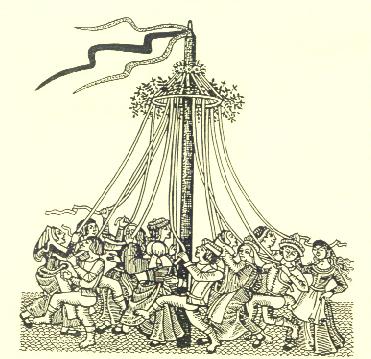
What am I doing for my birthday today? I'm at school teaching on my longest day of the week. I thought it might be interesting to share the nebulous history of this holiday-- Mayday. Here is a concise history on a site written a few years ago. I wonder why this holiday never fully caught on in the United States? It seems so fun--maypole dancing, delivering flowers to strangers, fertility rites? Hmmmmm

Tuesday, April 11, 2006

This Does Not Give Me Hope

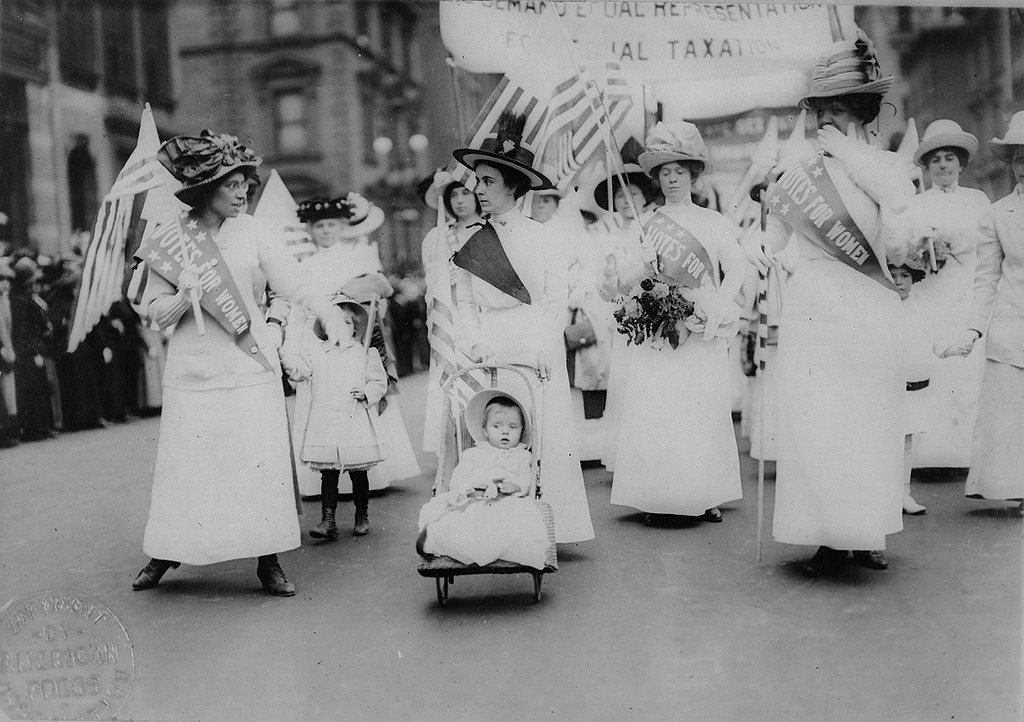
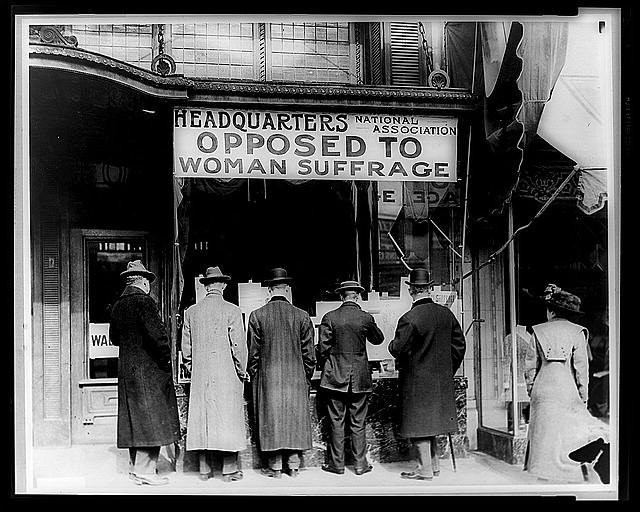
Feel like ending women's suffrage? These ladies do.

suffrage: def. the right to vote in a political election or the exercise of this right.

Wednesday, March 29, 2006

Fox News Faux Pas

The morally righteous and upstanding Fox News made yet another among a myriad of communication errors with a recent report on a serial killer--lest we forget that visual art and media are a form of visual COMMUNICATION. Just what is Fox News communicating with this video clip that is lambasted on The Daily Show? They usually offend me on a political level; now I am once again offended on a moral and aesthetic level. Could they have possibly showed a sketch of the suspected killer, pictures of the victims asking if anyone can identify them, crime scene shots of yellow tape, a written verbal description of the man or written, verbal instructions on how to avoid encountering him, or any other possibly related information to the subject at hand? Instead, Fox News chose to show the flesh fair that is Daytona Beach during spring break. I don't think I have to tell anyone the millions of things wrong with this. Someone should explain the concept of juxtaposition to their video editor. Thumbs way down, Fox News--you bastion of innacuracy and moral bankruptcy.

(incidentally, while Fox News pretends to come off morally righteous, they NEVER miss an opportunity to show flesh--it's the typical hypocrisy of the people who show you the flesh and then say, 'look! isn't this disgusting!' It is a ridiculous channel and barely above Star magazine, The National Enquirer, or Inside Edition in terms of being defined as news and possessing any truth whatsoever -- yellow journalism and the tackiest of aesthetics indeed)

Hilarious Commercials

No one dislikes television commercials more than I, but I do appreciate good ones when I see them. Volkswagon has some new ads in which Peter Stormare "unpimps" these hipsters' "rides" and replaces them with Volkswagon GTIs. Watch some of the commercials here.

Tuesday, March 21, 2006

V for Vendetta: Ideas Are Bulletproof


I have only this to say....Go see this movie while films with content of this sort are still legal. ; )

Friday, March 17, 2006

The Male Nude: Style and Substance


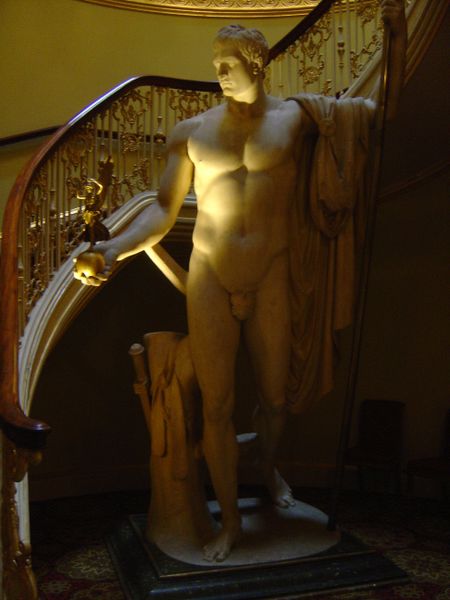
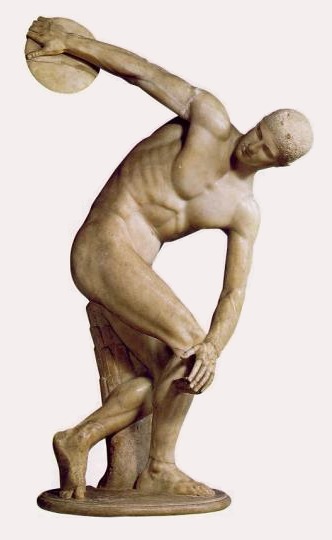
This is a very interesting article about the depiction of the male nude over time and context. The two best points made by the author of this commentary are 1) that the Greeks made the body (particularly the male--in the democratic, yet, un-egalitarian culture) a philosophy; and 2) that the body as depicted by Greeks is primarily intellectual and secondarily sexual; the order switches when personal style is introduced. "Greek athletes are abstract," says the author, Jonathan Jones. This is certainly a compelling point.

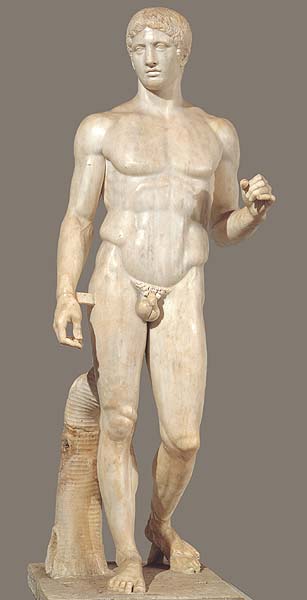
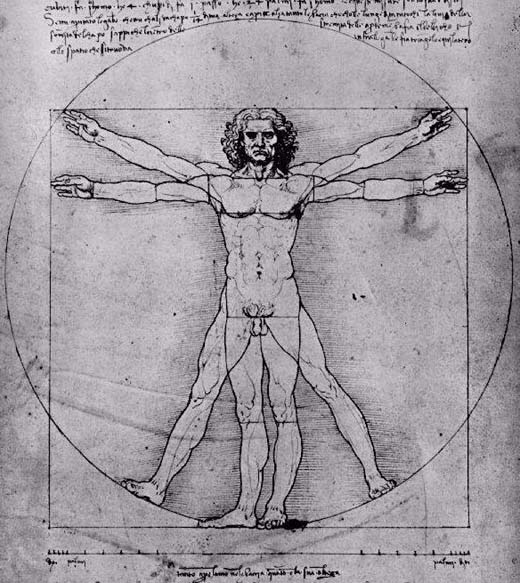
Jones discusses the comedic quality of Canova's statue of Napoleon in the Apsley House--it is both sexual and absurd. Then he takes us through ancient Greece, the Renaissance, the Baroque, and all the way up to modern fashion ads by Calvin Klein and Dolce & Gabbana. Polykleitos's famed canon of male proportions are highly intellectual and abstract; and, even though the character is muscular and nude, sexuality is secondary. Simply by the act of creating a "canon," almost all stylistic sexuality is dissolved. He points how Leonardo da Vinci's "Vitruvian Man" is cosmological and not sexual.

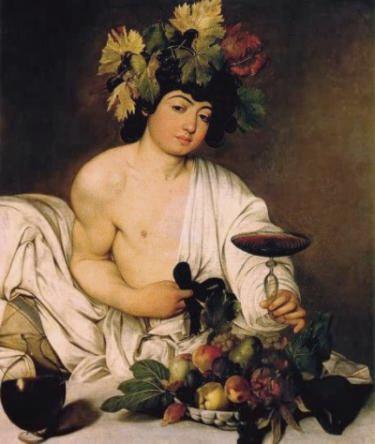
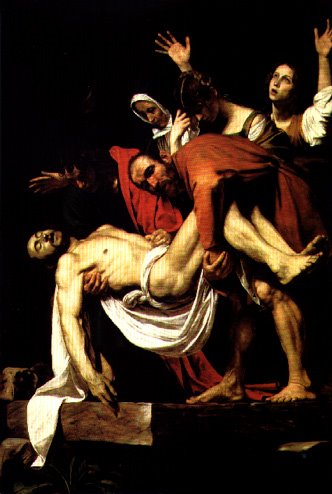
Caravaggio was no idealist. He showed people warts and all, and was not afraid of showing them in an unflattering light (no pun intended). Jones states that Caravaggio's Bacchus is clearly marked with the artist's style, thus sexualizing it. A statuesque figure of a street urchin becomes fleshy and real in form and in context/content and connotatively tactile and sensual. In Caravaggio's Deposition, "the nude has become unheroic, pitiful, and human." Donatello's David reeks with stylized sexuality. "David wears leg armour that sets off his nudity. His buttocks are emphasized. The bronze of an adolescent, hand on hip, huge sword in his hand, is mounted on marble and you walk right around him, painfully aware of the sensuality of the polished metal." Jones also argues that Church's denunciation of nudity during the Renaissance and Baroque periods only made the works more sexual/sensual (forbidden fruit).


The ancient Greek masculine figure was a mathematical and philosophical construction--almost too cerebral to be erotic. The figures were regular, systematic, and abstract with "crisp idealism." What actually confronts the viewer's feelings about sexuality (their own in particular) is an artist's particular style, not the nudity itself. This might not seem like a new idea, but Jones elucidates it in a humorous and intelligent way.

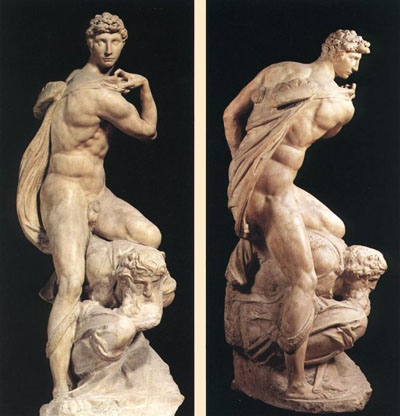
Other images mentioned in Jones's commentary....


Caravaggio, The Victorious Cupid

Myron, The Discus Thrower


Michelangelo, Victory


© Stephanie Lewis, 2006

Thursday, December 08, 2005

Monday, December 05, 2005

Postsecret


I added another link to my links at right. The site is called Postsecret. It's VERY interesting and sometimes moving and a site you can check again and again. Be forewarned: some of the language, information, and imagery may be objectionable to some.


Monday, November 28, 2005

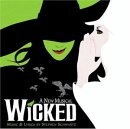
Review: Wicked, the Musical

____________________
Long before Dorothy dropped in, two other girls meet in the Land of Oz. One - born with emerald green skin - is smart, fiery and misunderstood. The other is beautiful, ambitious and very popular. How these two unlikely friends end up as the Wicked Witch of the West and Glinda the Good Witch makes for the most spellbinding new musical in years.
____________________

That's how the synopsis reads on the website for Wicked, the musical. And, like most synopses, it is woefully inadequate. The difficulty of writing a review or a synopsis is to avoid giving away too much of the plot so that people will still want to see it. This musical is about the origins of evil, what it means to be good, the mislabelling of people, tolerance, and of course, love and conflict.

I'll be honest...I'm very picky about what musicals I like. The genre has always baffled me. When I was a child, I enjoyed watching them, but had a quirky way of looking at them. I'd watch them and instead of paying attention to the performers, I used to stare at the people who would walk around in the background while the performers did their stuff. I used to wonder why these people didn't seem to notice the well-choreographed numbers and singing around them and walked around like nothing out of the ordinary was happening. Then, I would imagine what it would be like in real life if suddenly, you were waiting for a bus, or standing in line somewhere, and half the people around you broke into some musical number complete with dance choreography. Imagining this is actually how I got through countless waits in line. It could also be the reason, I love the musical Dancer in the Dark, starring Bjork (but that's a review for another time). Generally, I like musicals with some conflict and not the mindlessly optimistic ones. I also prefer musicals with generous amounts of dancing, having been a long admirer of the dance.

Wicked fulfilled all my needs in a musical. There was a lot of dancing in a variety of dance styles, the songs were beautiful and well-performed, the set was magnificent, and the talent involved was stunning. The musical also had an ample amount of conflict and even tackled a big philosophical subject: what is the nature of evil and conversely, what is the nature of good? And, as far as the L. Frank Baum book, "The Wizard of Oz," and the subsequent movie that we're all familiar with, no sacred cows were sacrificed.


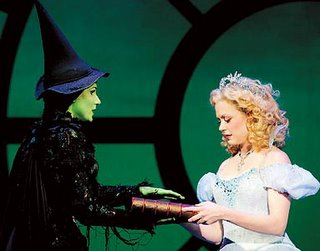
The story explores the lives of two women who came from different backgrounds. Galinda (later to become Glinda the Good) obviously comes from a priveleged background and charmed life, while Elphaba is despised by her own father and others because she has had the unfortunate circumstance of being born emerald green. Galinda and Elphaba are assigned as roommates in college, and as anyone who's had that experience can attest, it's not always a good match. Galinda is a vaccous, shallow, but popular woman, and Elphaba is smart and sassy, and not at all into what Galinda is into. She has been made to be consciously aware of her limitations her whole life, while Galinda cuts a swathe easily through any room and gains the admiration and sympathy of her peers. Galinda has an inflated view of herself and has appointed herself Elphaba's savior. Elphaba participates in a cause to defend the animals who have been forbidden to speak or have opinions or freedoms out of her obvious identification with them.

Galinda is not Elphaba's ONLY self-appointed "savior." Madame Morrible, the college's headmistress wants to take her under her wing since she shows an aptitude for sorcery, which also brings her the attention of the Wizard. Morrible and the Wizard have less than noble motives for using Elphaba's talent for sorcery, while Galinda moves from "loathing" her and making her into a project, to becoming her friend (though, in the end, she wouldn't admit this in mixed company).
____________________

Something has changed within me.
Something is not the same.
I'm through with playing by the rules
Of someone else's game.
Too late for second-guessing,
Too late to go back to sleep,
It's time to trust my instincts
Close my eyes: and leap!
It's time to try Defying gravity.
I think I'll try Defying gravity.
And you can't pull me down!


-- Elphaba in the song Defying Gravity
____________________

The treatment of Elphaba by Galinda, Morrible, and the Wizard prompt her to reject their rules of their "game." Elphaba chooses to defend the animals and fight Morrible and the Wizard. Galinda must walk the borderline because of politics. These relationships beg the discussion about what evil is. True, there are some individuals that are clearly "evil." But, a large number are clearly labeled as such because they are misunderstood or refuse to play by society's social mores. This is Elphaba's fate. She is misunderstood from the beginning because she is green and labeled evil by the authorities, because she won't participate in what she believes is immoral...and they have enough authority to convince the land of Oz that Elphaba is wicked.

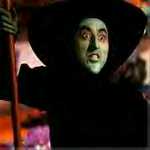
I'll be the first to admit that I identify more with Elphaba than Galinda. Even when I was young, I would watch the performance of Billie Burke as "Glinda the Good Witch" in the film and found her to be vaccous and somewhat sanctimonious. And, while I found Margaret Hamilton's performance as the "Wicked Witch of the West" to be somewhat scary, I found it more endearing and entertaining by the end of the film. There was always something likeable inside the character to me: that crazy laugh and hunched pose, the way she dramatically waved her fingers, her dark humor, and her habitat in the forbidden forest. I guess I saw her as more multi-dimensional than Glinda. Apparently, so did the writer of the story behind Wicked.
Without revealing too much about the plot, there are "cameo" appearances by Dorothy, the Scarecrow, the Tin Man, and the Cowardly Lion (whose origins are all explained). There is a love triangle between Galinda, Elphaba, and Fiyero, who is initially Galinda's kindred spirit and effervescent suitor. There is also a lot of humor and the tightest story I've seen or read in a long time: considering the author was tackling a sacred classic and the two main characters aren't explored much in the original novel or film. The story is clever, fun, meaningful, and touching all at the same time.

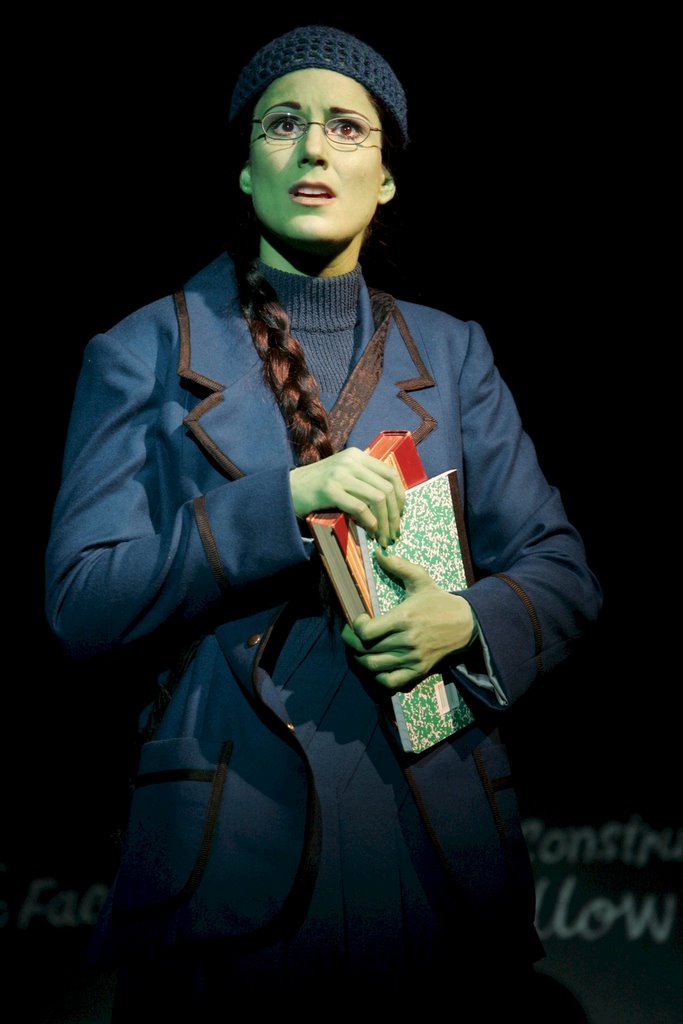
The performance we attended included actors Stephanie Block (Elphaba), understudy Emily Rozek (Galinda/Glinda), Derrick Williams (Fiyero), and David Garrison (the Wizard). Stephanie Block did a fantastic job playing Elphaba, but in my opinion, it was Emily Rozek that stole the show with her interpretation of the character of Glinda. I swear that I knew girls like that in college. She played Glinda in such a way that one could despise her, be annoyed by her, and still find her quite affable at the same time.


left: David Garrison; right: Derrick Williams

Finally, the set is magnificent in terms of construction, color scheme, and animatronics. Words simply aren't ample to describe the set. One spectacular part of the set is the talking giant, mechanical head of the Wizard. The costuming was a creative mix of Gay 90s attire mixed with derivations of the costuming from the original film. As a lover of the original film, I found it to be a tribute to the story, though I can see why some purists and those who prefer to believe in the polarity of good and evil would find it to be sub-par. Hopefully, most can put aside their preconceived notions and opinions and see Wicked as its own story.

* Lyrics can be found here.


© Stephanie Lewis, 2005

Wednesday, November 16, 2005

I'm Glad my Childhood is Not on Video

I think my younger sister's cohort was one of the last group of kids to not have their childhoods on VHS or DVD. I think I saw myself on someone's 8 mm film once when I was 12 and that was enough. It was very wierd seeing myself. Today, it's quite commonplace. I've often wondered how it has changed people's perceptions of the world and interaction with others, having seen themselves on film and having a different sort of self-awareness than most of us have gazing in a mirror. It is interesting to ponder--especially in post-Springer world.

I stumbled onto this gem this morning. The question is, do you think that THEY or this guy will be potentially more embarrassed in the future? The other question is, why did they choose an 80s dance repertoire for their medley? Another scary thing is that my childhood music is now considered "classic" or "oldies." It had to happen eventually.

Sunday, November 06, 2005

The Wonder Horse


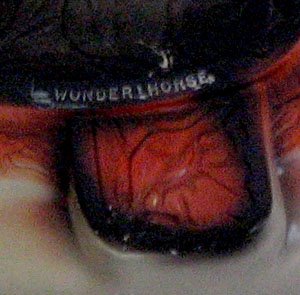
The other night at the 5 x 5 exhibition, one of my former students presented me with a gift. He was one of my first students at NWACC. A few years ago, in my drawing class, I had students bring still life items for the class to draw from. One day, he showed up with the Wonderhorse. I had very nostalgic feelings about the Wonderhorse that he brought. It was the EXACT model I had when I was small. I spent hours upon hours riding the spring-mounted horse in my basement when I was a child until I got too big to ride it.

Two nights ago, toward the end of the exhibition, he came waltzing into the room with the Wonderhorse under his arm. He had tied a bow around its neck and handed it to me. The horse was somewhat worse-for-wear, having a broken leg in an attached ziploc bag and the rear, a wooden support, and the wooden hand grips missing. I stood around for a few minutes with it under my arm surrounded by the inquisitive glances of the exhibition attendees. Later, I carried it out of the ACO and took it home with me.

I was a little concerned about what I was going to do with the horse since my house is very full of art and artifacts. I decided I'd put it in a prominent place on top of my kitchen cabinets under a 9-foot ceiling. I now see it immediately when I walk in the room and am reminded of happy times in my childhood. It was a very nice and thoughtful gift.