
Showing posts with label exhibitions. Show all posts
Showing posts with label exhibitions. Show all posts
Sunday, April 26, 2009
Winners from the Spring Student Show -- 2009
This semester was a banner semester for my Introduction to Painting students. I had 10 students have 13 paintings win honorable mentions or better. Yea!


Saturday, March 29, 2008
ART CLASSIC #6
Inside-Out, Outside-In:
The Self as Spectacle
"myspace"
Installation (1) on the University of Arkansas Union Courtyard
March 14 - April 5, 2008
by Kelsey Felthousen
Yesterday, I was driving to work and thinking about Americans' notions about privacy--how we put it all out there on myspace, Facebook, or even here on Blogger, etc. We're acclimated to talk shows where people spill their guts about extraordinarily personal things on television transmitted out to millions of strangers, not to mention "reality shows" that have been added to that mix as well. We're so comfortable or have been made to feel so comfortable at exposing ourselves, there's barely a peep from the culture in reaction to our government's surveillance of its own citizens.
Perhaps it was kismet, but after my morning drive, I arrived at my office where a colleague* had left a newspaper article (2) about Kelsey Felthousen's Master's Thesis Exhibition at the University of Arkansas. Kelsey describes her project as
Typically, I write my "Art Classics" about works from relatively near and distant art history. But, I think I'll preempt art history on this one and say this is an instant Art Classic and will probably be so in the future.
Images from Kelsey Felthousen's Exhibition
* Special thanks to Eric Smith who gave me the article on Kelsey yesterday. Eric and I have been on the same creative wavelength for 13 years now and he is a wealth of information that I cherish.
(1) http://www.artlex.com
(2) http://www.nwarktimes.com/nwat/News/63540
(3) http://art.uark.edu/fineartsgallery/?p=45 ; Kelsey says that two of her big influences are Ann Hamilton and Vito Acconci.
(4) "Art in which works in any of a variety of media are executed premeditated before a live audience. Although this might appear to be theater, theatrical performances present illusions of events, while performance art presents actual events as art. One of the things setting postmodernism apart from modernism is its acceptance of aspects of theater. Performance elements surfaced in a number of conceptual art movements of the 1960s, including: Fluxus, Happenings, body art, process art, street works, etc. The 1980s saw the emergence of performance artists like David Byrne (American) and Laurie Anderson (American, 1947-), who had each been students of visual art, but whose work gradually incorporated voice, music, costumes, projected image, stage lighting, etc. " (http://www.artlex.com ; definition of "performance art")
(5) http://www.myspace.com
(6) In psychology, there is a projective test in which patients are asked to draw a house, a tree, and a person. Once analyzed, these images will reveal personal information about the patient. For instance, drawing a pronounced knothole in a tree often reflects trauma. If the windows of the house are missing or covered, there is an issue with boundaries and privacy. In religion--Christianity for example-- Jesus compares the spiritual self to a house on rock or a house on sand, and that is one of many religious examples across religions.
(7) http://www.magritte.com/
Installation (1) on the University of Arkansas Union Courtyard
March 14 - April 5, 2008
by Kelsey Felthousen
Yesterday, I was driving to work and thinking about Americans' notions about privacy--how we put it all out there on myspace, Facebook, or even here on Blogger, etc. We're acclimated to talk shows where people spill their guts about extraordinarily personal things on television transmitted out to millions of strangers, not to mention "reality shows" that have been added to that mix as well. We're so comfortable or have been made to feel so comfortable at exposing ourselves, there's barely a peep from the culture in reaction to our government's surveillance of its own citizens.
Perhaps it was kismet, but after my morning drive, I arrived at my office where a colleague* had left a newspaper article (2) about Kelsey Felthousen's Master's Thesis Exhibition at the University of Arkansas. Kelsey describes her project as
“(dealing) with the notions of an overexposed, vulnerable society that…feels unprotected. When creating this work I chose to broach the subject of sacred/private space and how that space is being given away freely, without thought of the consequences.”Of course, after my morning musings and reading the article, I HAD to go see the installation. It's imperative to see an art installation in person because they are time-limited and are meant to be experienced physically.“Sacred Space, as defined in this exhibition, is the preciousness of close relationships and the privacy within our lives and homes. One need not search far for evidence of this exposure. It can be seen in all aspects of our society, from television programming to technology.” (3)
Typically, I write my "Art Classics" about works from relatively near and distant art history. But, I think I'll preempt art history on this one and say this is an instant Art Classic and will probably be so in the future.
Images from Kelsey Felthousen's Exhibition
First, it is a privilege and a pleasure to view such a cutting-edge, intellectually-stimulating, and culturally relevant work of contemporary art. It is an oasis in the desert that is the dearth of such works in Northwest Arkansas.
 Kelsey Felthousen (right)
What I respond to most are the layers of experience embodied in the work. First, it is both installation and performance art (4). Installation is already part sculpture, so one could say there are three immediate layers perceived. The piece is constructed of a central area that is a wood-framed square with the siding for the "house" on the inside. There is a door to enter the "garden" on this "inside" area where there is no roof. Tulips and pansies comprise the garden. The "rooms" of the "house" are outside this square exposed to the elements splayed out on the four sides on various floor substrates in a cloverleaf pattern. The rooms are comprised of variously familiar and comfortable furnishings and knick-knacks that make a "house" a "home." But this "home" is decidedly uncomfortable and vulnerable. It's as if Jeff Goldblum sent a normal house through his infamous teleporting machine and once again, point B came out as something quite unexpected.
The piece is present and massive like sculpture but open to the point of encouraging almost socially inappropriate interaction. There's a natural hesitancy in most people when it comes to entering strangers' homes, but this stranger has opened her house and the exhibition goers react accordingly. On the evening of the reception on March 28, snacks were placed in the "kitchen" and "living room" of this "house". One could see the body language of exhibition goers quickly transform to extremely casual mode. They sat on the furniture, ate her food, looked through her cabinets, used her microwave, entered her garden, and used her barbeque pit to cook. Social boundaries had clearly broken down in a matter of seconds.
My favorite view of the installation is the view through the kitchen window. As with many homes, you expect to see a garden and you do. However, this garden is enclosed and the area is in shade. The siding of the "house" can bee seen from that window as well, creating cognitive dissonance. At once, the viewer thinks that he or she is looking into a room and into a garden outside. There is no roof to this room and it is not really a garden. It is theater, theater in which one has no real inkling of the character or identity of the "actor" -- sort of like myspace®. (5)

Typically, houses represent the self as symbols. This fact has been true historically in art, literature, psychology, and even religion. (6) People in normal houses keep the inside enclosed and private, and decorate the outside of their houses to create a veneer of normalcy to the outside world. In the case of this installation, the garden is protected and the resident's private effects are exposed to inspection and scrutiny. It's not until one enters the garden and stands inside that one realizes that the private self is no better protected as there is no roof. Privacy has become an illusion. The self as represented by the house becomes an illusion, a theatrical performance, and a dance between vulnerability and invulnerability; and indeed, a dance with the devil, and as compelling as any Magritte (7) painting.
 View of the gallery part of the installation
As I said earlier, there are many layers of experience to this installation. The second layer takes place in the Fine Arts Gallery inside the Fine Arts Building. There is another living area set up in the empty gallery facing what appears to be a television but is a giant computer monitor broadcasting the University of Arkansas Central Quad webcam that is trained on Kelsey's installation. Visitors eat snacks off of a coffee table and can sit at a desk or sit on a couch or chair and view the installation in real time on the large screen. The self thereby becomes a spectacle, and the viewers in the gallery, voyeurs. We have been acclimated to this role for quite some time since the advent of television. "Reality" television makes us even more comfortable with our inner voyeurs. At least some sort of relationship between the artist and the viewing public is encouraged at the physical site of the installation, but this is lost through the physical and digital distancing of the computer monitor. It was not as astounding to see individuals in the gallery as comfortable with boundary-breaking as the visitors to the physical site were because we are so familiar with this scene.
 In yet another layer, one realizes from watching the monitor in the gallery, that the webcam is also seen by anyone who encounters it. Also, in a more disturbing twist, the University webcam is fully controllable by those people. So, as one watches the monitor, one is watching a watcher who is a stranger. This stranger may just center the installation and watch it from a distance, they may zoom in on her "bedroom", or they may even focus the webcam on an individual as they walk by and "follow" them while they are doing so. The webcam is not fixed or controlled by one director but is essentially a production of many strangers who are essentially as voyeuristic as the people in the gallery. The irony is this aspect of watching the watchers--essentially making us all spectacles. And that seems to be the nature of modern life--so many people have abdicated their privacy and made themselves spectacles that we all become part of the "show."
The performance art aspect of this show is the fact that Kelsey lives in her installation--submitting herself to the intrusions and glances. A lot of individuals do this in day to day life with little thought to the consequences. She therefore becomes exposed to the elements and what would normally be unwanted behaviors and gestures.
I said earlier that myspace was intellectually-stimulating and culturally-relevant. To me, these are two very important qualities to qualify a work as an art classic. The layers of complexity and even humor make this piece intellectually-stimulating. It is a very difficult thing for an artist to hit the sweet spot in terms of timing in a culture, and Kelsey does it with smarts and gusto. She reveals something about us as human beings in the here and now as a world moves from a culture that sees to one that is seen and dare I say, with a dash of beauty, my other criteria for an art classic. I am going to watch her career and would encourage others to do so. This is not the last we'll see of Kelsey Felthousen.
© Stephanie Lewis, 2008
 Kelsey Felthousen (right)
What I respond to most are the layers of experience embodied in the work. First, it is both installation and performance art (4). Installation is already part sculpture, so one could say there are three immediate layers perceived. The piece is constructed of a central area that is a wood-framed square with the siding for the "house" on the inside. There is a door to enter the "garden" on this "inside" area where there is no roof. Tulips and pansies comprise the garden. The "rooms" of the "house" are outside this square exposed to the elements splayed out on the four sides on various floor substrates in a cloverleaf pattern. The rooms are comprised of variously familiar and comfortable furnishings and knick-knacks that make a "house" a "home." But this "home" is decidedly uncomfortable and vulnerable. It's as if Jeff Goldblum sent a normal house through his infamous teleporting machine and once again, point B came out as something quite unexpected.
The piece is present and massive like sculpture but open to the point of encouraging almost socially inappropriate interaction. There's a natural hesitancy in most people when it comes to entering strangers' homes, but this stranger has opened her house and the exhibition goers react accordingly. On the evening of the reception on March 28, snacks were placed in the "kitchen" and "living room" of this "house". One could see the body language of exhibition goers quickly transform to extremely casual mode. They sat on the furniture, ate her food, looked through her cabinets, used her microwave, entered her garden, and used her barbeque pit to cook. Social boundaries had clearly broken down in a matter of seconds.
My favorite view of the installation is the view through the kitchen window. As with many homes, you expect to see a garden and you do. However, this garden is enclosed and the area is in shade. The siding of the "house" can bee seen from that window as well, creating cognitive dissonance. At once, the viewer thinks that he or she is looking into a room and into a garden outside. There is no roof to this room and it is not really a garden. It is theater, theater in which one has no real inkling of the character or identity of the "actor" -- sort of like myspace®. (5)

Typically, houses represent the self as symbols. This fact has been true historically in art, literature, psychology, and even religion. (6) People in normal houses keep the inside enclosed and private, and decorate the outside of their houses to create a veneer of normalcy to the outside world. In the case of this installation, the garden is protected and the resident's private effects are exposed to inspection and scrutiny. It's not until one enters the garden and stands inside that one realizes that the private self is no better protected as there is no roof. Privacy has become an illusion. The self as represented by the house becomes an illusion, a theatrical performance, and a dance between vulnerability and invulnerability; and indeed, a dance with the devil, and as compelling as any Magritte (7) painting.
 View of the gallery part of the installation
 In yet another layer, one realizes from watching the monitor in the gallery, that the webcam is also seen by anyone who encounters it. Also, in a more disturbing twist, the University webcam is fully controllable by those people. So, as one watches the monitor, one is watching a watcher who is a stranger. This stranger may just center the installation and watch it from a distance, they may zoom in on her "bedroom", or they may even focus the webcam on an individual as they walk by and "follow" them while they are doing so. The webcam is not fixed or controlled by one director but is essentially a production of many strangers who are essentially as voyeuristic as the people in the gallery. The irony is this aspect of watching the watchers--essentially making us all spectacles. And that seems to be the nature of modern life--so many people have abdicated their privacy and made themselves spectacles that we all become part of the "show."
The performance art aspect of this show is the fact that Kelsey lives in her installation--submitting herself to the intrusions and glances. A lot of individuals do this in day to day life with little thought to the consequences. She therefore becomes exposed to the elements and what would normally be unwanted behaviors and gestures.
I said earlier that myspace was intellectually-stimulating and culturally-relevant. To me, these are two very important qualities to qualify a work as an art classic. The layers of complexity and even humor make this piece intellectually-stimulating. It is a very difficult thing for an artist to hit the sweet spot in terms of timing in a culture, and Kelsey does it with smarts and gusto. She reveals something about us as human beings in the here and now as a world moves from a culture that sees to one that is seen and dare I say, with a dash of beauty, my other criteria for an art classic. I am going to watch her career and would encourage others to do so. This is not the last we'll see of Kelsey Felthousen.
© Stephanie Lewis, 2008
* Special thanks to Eric Smith who gave me the article on Kelsey yesterday. Eric and I have been on the same creative wavelength for 13 years now and he is a wealth of information that I cherish.
(1) http://www.artlex.com
(2) http://www.nwarktimes.com/nwat/News/63540
(3) http://art.uark.edu/fineartsgallery/?p=45 ; Kelsey says that two of her big influences are Ann Hamilton and Vito Acconci.
(4) "Art in which works in any of a variety of media are executed premeditated before a live audience. Although this might appear to be theater, theatrical performances present illusions of events, while performance art presents actual events as art. One of the things setting postmodernism apart from modernism is its acceptance of aspects of theater. Performance elements surfaced in a number of conceptual art movements of the 1960s, including: Fluxus, Happenings, body art, process art, street works, etc. The 1980s saw the emergence of performance artists like David Byrne (American) and Laurie Anderson (American, 1947-), who had each been students of visual art, but whose work gradually incorporated voice, music, costumes, projected image, stage lighting, etc. " (http://www.artlex.com ; definition of "performance art")
(5) http://www.myspace.com
(6) In psychology, there is a projective test in which patients are asked to draw a house, a tree, and a person. Once analyzed, these images will reveal personal information about the patient. For instance, drawing a pronounced knothole in a tree often reflects trauma. If the windows of the house are missing or covered, there is an issue with boundaries and privacy. In religion--Christianity for example-- Jesus compares the spiritual self to a house on rock or a house on sand, and that is one of many religious examples across religions.
(7) http://www.magritte.com/
Friday, December 07, 2007
Thursday, July 19, 2007
Chilly Portraits
Matt Hoyle exhibits his photographic portraits at the Point of View Art Gallery in an exhibition called Icebergs.


Tuesday, May 22, 2007
Art Minute from ArtInfo.com: Richard Serra
Above: Richard Serra's Torqued Ellipse IV (1998) and Intersection II (1992) being installed in the Abby Aldrich Rockefeller Sculpture Garden at The Museum of Modern Art in preparation for "Richard Serra Sculpture: Forty Years" (June 3-September 10, 2007).
Music courtesy of I am Robot and Proud from the album Grace Days on Catmobile Records. For more information on I am Robot and Proud, please visit http://www.robotandproud.com
© 2007 The Museum of Modern Art, New York
Thursday, May 10, 2007
Sofa? Car?

Li Hui's piece Sofa? Car? appears in May's Art in America. It's his modified Fiat 126P with sofa that appeared in a Shanghai exhibition at Contrasts Gallery called "Crossover: Beyond Art and Design." Clever and fun! Perfect for the car lovin' couch potato!
Li Hui's biography at Artnet
Friday, April 20, 2007
Comic Abstraction
 Speech Bubbles, by Philippe Parreno, mylar and helium, 1997
The MoMA has a great online exhibition. It's called "Comic Abstraction" and it is on view from March 4 - June 11, 2007 if you want to check it out. There are interviews you can read as well as audio commentary.
Here is an excerpt that describes the exhibition from the MoMA website....
"In recent years a number of artists have transmuted the lexicon of comic strips and films,cartoons, and animation into a new, representational mode of "comic abstraction" to address perplexing issues about war and global conflicts, the legacy of September 11, and ethnic and cultural stereotyping. From Julie Mehretu's intricately layered paintings—in which she uses cartoon explosions to portray the changing histories of civilizations as a result of warfare—to Arturo Herrera's psychological collages, made by slicing and reconfiguring the pages of Walt Disney coloring books, and from Ellen Gallagher's seductively Minimalist paintings permeated by "blackface" signs culled from minstrel performances to Rivane Neuenschwander's wiped-out cartoon characters in the series Zé Carioca, the world of comic abstraction reflects the intensely personal relationship that many contemporary artists maintain with the political makeup of the world. The image of popular culture is so imprinted in our consciousness that the partial or total erasure of its iconography always remains recognizable. Bridging the rift between abstract form and social consciousness in ways that are critical and playful in tandem, this exhibition presents the first investigation into the experimental outgrowths of comic abstraction." (1)
Wednesday, December 20, 2006
Exhibition Highly Recommended

The exhibit of Eudora Welty's photographs at the Walton Arts Center is exquisite. Check it out.
On display from December 4, 2006 to February 17, 2007.
Sunday, November 27, 2005
Girls' Night Out
Cindy Sherman's work was only a small part of the exhibit at the St. Louis Contemporary Museum of St. Louis. The most notable piece was Doll Clothes, a three-minute silent animated video from 1975, which was being exhibited for the first time. In the film, the artist "appears as a paper doll that has come to life and tries on clothes stored in their clear plastic sleeves" (Andrea Green, Curatorial Assistant). In the exhibition catalog, Author Catherine Morris states "Rather than make a film in which she actually appears, Sherman chooses to make a film about photographic representation of herself in arrested moments of movement. The removal of herself as subject, while retaining her body as a backdrop for an imaginary construction, characterizes that her mature work has begun." I personally saw that this video piece was a very distinct foreshadowing of all of her identity pieces to come. Cindy Sherman is a particularly salient example of an artist who latches onto a theme and explores it throughout their artistic career in various ways so that in the end, it is FULLY explored.
The rest of the exhibition space was filled with work by two generations of female artists working today in an exhibition entitled Girls' Night Out. The work was primarily photography and video. One particularly good artist/filmmaker to me was Salla Tykkä, who was born in 1973 and lives in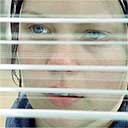 Helsinki. Her photographic stills were not as stiking as a film of hers that was included in the exhibition. The film was called Thriller, and read like a bizarre dream of a pre-pubescent girl. There is gazing in windows and gazing out of windows. There is a man searching for the girl, and in the end, leaving her alone in her bed. At one point, the girl finds a gun while chasing after the man, and shoots a sheep with it, while another girl burns brush outside the original house. The setting is a forested area after rain and on a cloudy day. Throughout the short film, the theme song from the movie Halloween is playing. Overall, the film is a disconcerting exploration of the themes of "coming of age," or "loss of image" from a clear, albeit surrealistic, feminine perspective. Here is an article on Salla Tykkä in The Guardian by Adrian Searle for further reading.
The rest of the exhibition space was filled with work by two generations of female artists working today in an exhibition entitled Girls' Night Out. The work was primarily photography and video. One particularly good artist/filmmaker to me was Salla Tykkä, who was born in 1973 and lives in
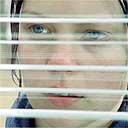 Helsinki. Her photographic stills were not as stiking as a film of hers that was included in the exhibition. The film was called Thriller, and read like a bizarre dream of a pre-pubescent girl. There is gazing in windows and gazing out of windows. There is a man searching for the girl, and in the end, leaving her alone in her bed. At one point, the girl finds a gun while chasing after the man, and shoots a sheep with it, while another girl burns brush outside the original house. The setting is a forested area after rain and on a cloudy day. Throughout the short film, the theme song from the movie Halloween is playing. Overall, the film is a disconcerting exploration of the themes of "coming of age," or "loss of image" from a clear, albeit surrealistic, feminine perspective. Here is an article on Salla Tykkä in The Guardian by Adrian Searle for further reading.
Wednesday, November 23, 2005
Cindy Sherman at the Contemporary Art Museum of St. Louis
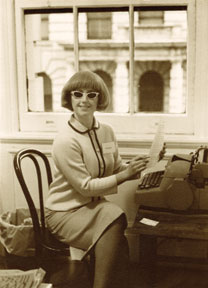
This coming Saturday, I get to see this exhibit. I'm very excited since I have NEVER seen a collection of multiple Cindy Sherman pieces in one place. To me, Cindy Sherman is to contemporary photography as Lon Chaney was to film. Her transformations of self are amazing, intriguing, and sometimes disturbing. She morphs so easily into the various identities women find themselves possessing or being possessed by. Look in future entries for my review of the exhibit. My boyfriend and I are also going to see the musical "Wicked" at the Fox Theatre and I will be reviewing that as well.
Wednesday, November 16, 2005
Tuesday, November 15, 2005
My Trip to Chi-Town
I flew out of XNA on November 9 in the morning. One of my students whom I've been carpooling with, used to work for the airlines and graciously gave me one of her buddy passes AND drove me to the airport, AND loaned me her cell phone for the trip. She'll never know how grateful I am. My flight to Atlanta, and then to Chicago was uneventful.
Once I got my rental car, I was reminded anew how similar the Chicago highway system is similar to St. Louis's (my hometown). So, Chicago is always somewhat familiar to me even though I don't spend much time there.
 Upon arrival, I was greeted by my cousin's wife and four year old daughter. She calls me "Aunt Steph" even though we are really second cousins--because her dad is really like a brother to me. However, she didn't recognize me right away--four year old memories being what they are. Later that afternoon at the dinner table, she leaned in and said, "So. My dad says that your a good artist." I said, "Hey! I thought you didn't know who I was!" She laughed. I said, "Some think so." She said, "My grandpa's a good
 artist too." This brief discussion was basically par for the course between me and Maddie during this trip. We spent loads of time playing pretend games and drawing too. It was also the first time I met my new little cousin Kayla.
I drove downtown the day of the reception and arrived about 3 hours before the event so I could wander around. I first went to find the gallery, and when I got there, I took photos of the art on the walls while the room was empty. After leaving the gallery, I found this novelty and poster store and spent most of my time there, killing time. Then, I grabbed a bite to eat a few blocks away from the gallery. I had this strange waiter who kept looking at me like he knew me--or at least like I had another eye in the middle of my forehead. It was rather strange. I asked if there were any discarded papers and he brought me one, so I parused that and tried the crossword.
It was about 15 minutes until five when I walked down to the gallery. People were already there, even though the snacks and drinks weren't ready yet. I immediately met with Karen Egerer, the organizer of the event/exhibition through Heartland International. Karen introduced me to Michael Ensdorf, the Director of the Gage Gallery at Roosevelt University, and Gregory G. Knight, the Director of Visual Arts at the Chicago Department of Cultural Affairs, and Chief Curator of Exhibitions at the Chicago Cultural Center. Susan Aurinko, Director of FLATFILE Galleries and also the third juror, was unable to attend.
 I spent some time talking about my piece with Michael. He had an interesting interpretation on it. Interesting, not because I can't see his point, but because I didn't really have the particular issue in mind when I made the image. We talked about how the multiplicity of interpretations is an asset and not a liability and opens dialogue. As the evening progressed, I found out that not only did we have similar jobs, but also similar philosophies--just in two different places in the country.
As the evening progressed, I met artists who were in the exhibition with me as well as other artists who often engaged in some conspicous self-marketing. I admired their moxy and walked away with several of their cards. I spent most of the evening talking to a financial planner from Mass Mutual, of all places. He had some intriguing ideas about politics and was planning to write a novel at some time in the future. He and I also chatted at length with one of the other artists and her daughter about the state of the world and politics.
After the reception was over, Michael invited me to go to dinner with he and his wife's friends at the Park Cafe. We all had great philosophical discussions about art, education, creativity, motivation and all the other deep things artists, arts educators, and arts administrators talk about when they are together. The ambience of the restaurant was also very nice and the food was nearly perfect. After dinner, Michael made sure I made it safely to my car in the parking garage and I dropped him off at his car.
 The rest of the time I was in Chicago, I went to Ikea with my cousin-in-law and we had lunch. I had Swedish meatballs for the first time in forever. We wandered the store for the afternoon and I thoroughly enjoyed all the efficient Swedish (and Scandinavian, to be honest) domestic engineering. That evening we had some yummy pizza and I spent some time with my cousin.
The next afternoon, I flew back to Arkansas.
Here are some artists who presented me with their cards:
Roland Kulla
Andrea Harris
Andrea Harris also promoted BettyAnn Mocek.
Renee McGinnis
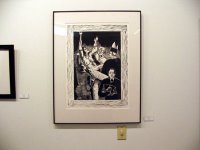
Finally, here are some images from the gallery:
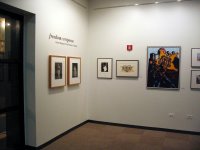
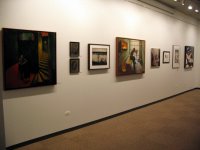


Once I got my rental car, I was reminded anew how similar the Chicago highway system is similar to St. Louis's (my hometown). So, Chicago is always somewhat familiar to me even though I don't spend much time there.
 Upon arrival, I was greeted by my cousin's wife and four year old daughter. She calls me "Aunt Steph" even though we are really second cousins--because her dad is really like a brother to me. However, she didn't recognize me right away--four year old memories being what they are. Later that afternoon at the dinner table, she leaned in and said, "So. My dad says that your a good artist." I said, "Hey! I thought you didn't know who I was!" She laughed. I said, "Some think so." She said, "My grandpa's a good
 artist too." This brief discussion was basically par for the course between me and Maddie during this trip. We spent loads of time playing pretend games and drawing too. It was also the first time I met my new little cousin Kayla.
I drove downtown the day of the reception and arrived about 3 hours before the event so I could wander around. I first went to find the gallery, and when I got there, I took photos of the art on the walls while the room was empty. After leaving the gallery, I found this novelty and poster store and spent most of my time there, killing time. Then, I grabbed a bite to eat a few blocks away from the gallery. I had this strange waiter who kept looking at me like he knew me--or at least like I had another eye in the middle of my forehead. It was rather strange. I asked if there were any discarded papers and he brought me one, so I parused that and tried the crossword.
It was about 15 minutes until five when I walked down to the gallery. People were already there, even though the snacks and drinks weren't ready yet. I immediately met with Karen Egerer, the organizer of the event/exhibition through Heartland International. Karen introduced me to Michael Ensdorf, the Director of the Gage Gallery at Roosevelt University, and Gregory G. Knight, the Director of Visual Arts at the Chicago Department of Cultural Affairs, and Chief Curator of Exhibitions at the Chicago Cultural Center. Susan Aurinko, Director of FLATFILE Galleries and also the third juror, was unable to attend.
 I spent some time talking about my piece with Michael. He had an interesting interpretation on it. Interesting, not because I can't see his point, but because I didn't really have the particular issue in mind when I made the image. We talked about how the multiplicity of interpretations is an asset and not a liability and opens dialogue. As the evening progressed, I found out that not only did we have similar jobs, but also similar philosophies--just in two different places in the country.
As the evening progressed, I met artists who were in the exhibition with me as well as other
 artists who often engaged in some conspicous self-marketing. I admired their moxy and walked away with several of their cards. I spent most of the evening talking to a financial planner from Mass Mutual, of all places. He had some intriguing ideas about politics and was planning to write a novel at some time in the future. He and I also chatted at length with one of the other artists and her daughter about the state of the world and politics.
After the reception was over, Michael invited me to go to dinner with he and his wife's friends at the Park Cafe. We all had great philosophical discussions about art, education, creativity, motivation and all the other deep things artists, arts educators, and arts administrators talk about when they are together. The ambience of the restaurant was also very nice and the food was nearly perfect. After dinner, Michael made sure I made it safely to my car in the parking garage and I dropped him off at his car.
 The rest of the time I was in Chicago, I went to Ikea with my cousin-in-law and we had lunch. I had Swedish meatballs for the first time in forever. We wandered the store for the afternoon and I thoroughly enjoyed all the efficient Swedish (and Scandinavian, to be honest) domestic engineering. That evening we had some yummy pizza and I spent some time with my cousin.
The next afternoon, I flew back to Arkansas.
Here are some artists who presented me with their cards:
Roland Kulla
Andrea Harris
Andrea Harris also promoted BettyAnn Mocek.
Renee McGinnis
Finally, here are some images from the gallery:

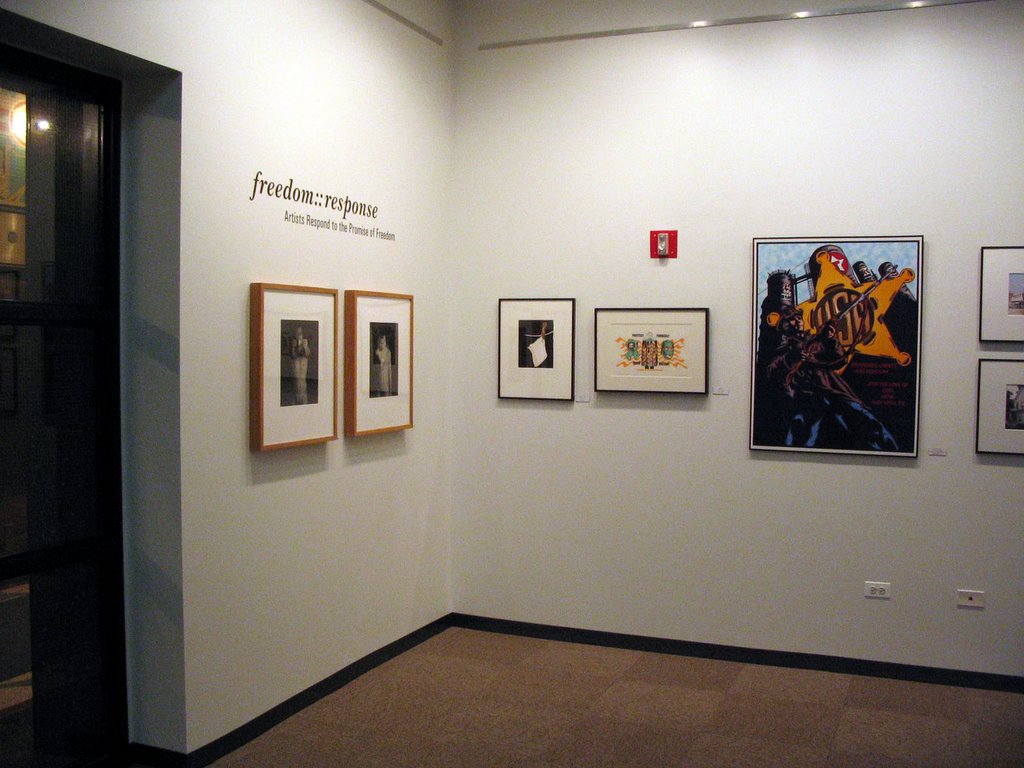

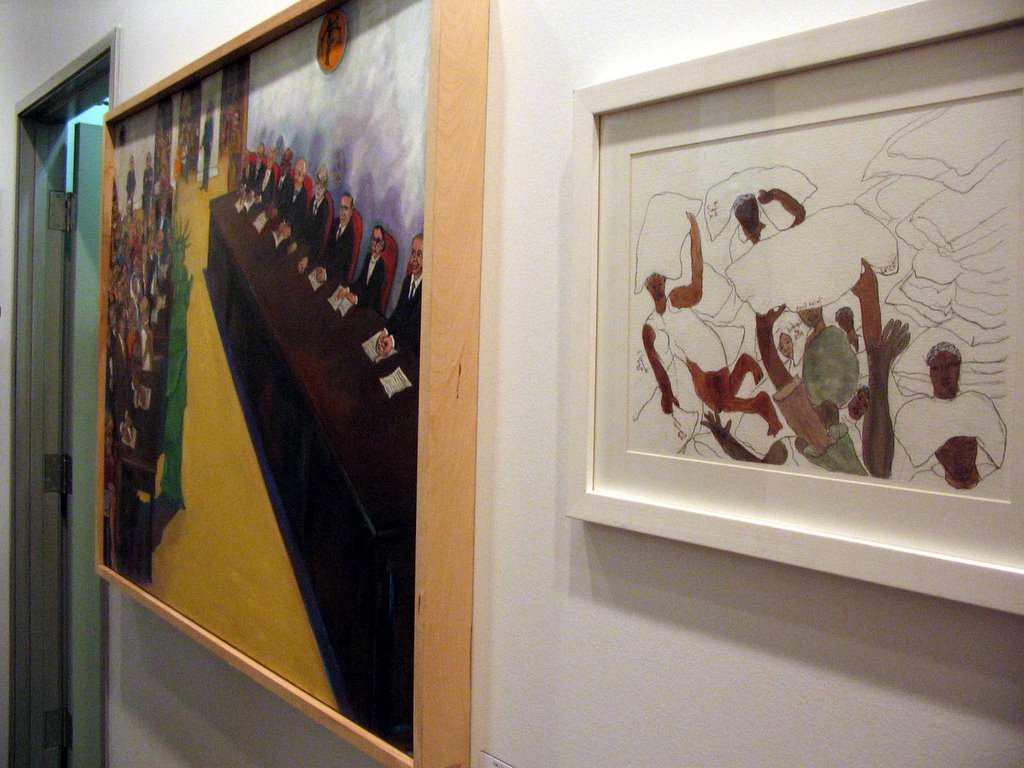
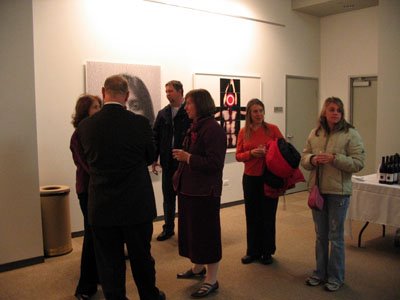
Monday, November 14, 2005
freedom::response Exhibit Highlights
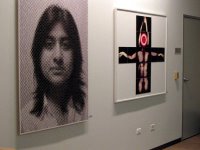
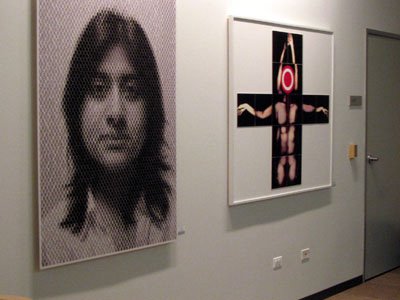
I should be writing about my experience in Chicago sometime this week, but I thought I'd share some image highlights with you in the interim. Here were three that stood out to me in the exhibit of 29 pieces.
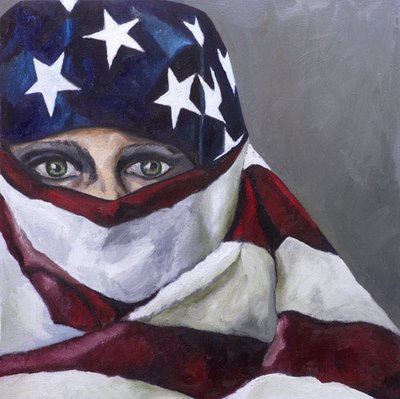
Self-Portrait, by Andrea Harris, oil and wax, 24" x 24"
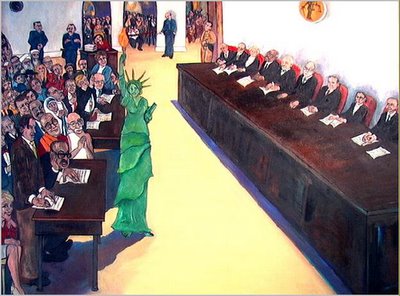
The Supremes, by Nancy Calef, oil, 36" x 48"
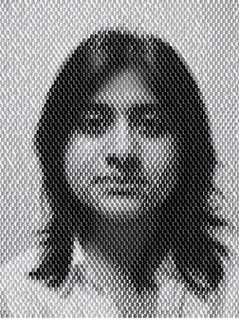
Arwa-India, by Anni Holm, photograph (image comprised of fingerprints)
Sunday, November 06, 2005
The Wonder Horse

The other night at the 5 x 5 exhibition, one of my former students presented me with a gift. He was one of my first students at NWACC. A few years ago, in my drawing class, I had students bring still life items for the class to draw from. One day, he showed up with the Wonderhorse. I had very nostalgic feelings about the Wonderhorse that he brought. It was the EXACT model I had when I was small. I spent hours upon hours riding the spring-mounted horse in my basement when I was a child until I got too big to ride it.
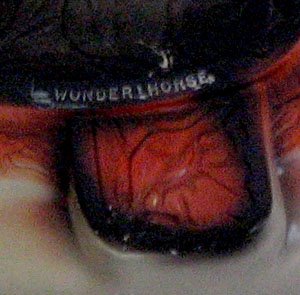
Two nights ago, toward the end of the exhibition, he came waltzing into the room with the Wonderhorse under his arm. He had tied a bow around its neck and handed it to me. The horse was somewhat worse-for-wear, having a broken leg in an attached ziploc bag and the rear, a wooden support, and the wooden hand grips missing. I stood around for a few minutes with it under my arm surrounded by the inquisitive glances of the exhibition attendees. Later, I carried it out of the ACO and took it home with me.
I was a little concerned about what I was going to do with the horse since my house is very full of art and artifacts. I decided I'd put it in a prominent place on top of my kitchen cabinets under a 9-foot ceiling. I now see it immediately when I walk in the room and am reminded of happy times in my childhood. It was a very nice and thoughtful gift.

Saturday, November 05, 2005
The Third Annual 5 x 5 Exhibition
The party went well last night. There were a lot of new faces and positive energy. It was interesting to see how switching to silent auction affected the crowd's behavior. They seemed to come in more slowly and hold back on their bidding until the end. It was much more casual then the first come, first serve rush. It was nice that the food and wine were donated. Both were excellent in presentation and taste.
Subscribe to:
Posts (Atom)


