

Showing posts with label painting. Show all posts
Showing posts with label painting. Show all posts
Saturday, October 11, 2008


Saturday, August 11, 2007

Saturday, July 21, 2007
Cy Twombly Would Probably Love Her for It
News Article
 Cy Twombly, Leda and The Swan; 1962 Oil, pencil and crayon
on canvas 6' 3" x 6' 6 3/4" (190.5 x 200 cm)
 Cy Twombly, Leda and The Swan; 1962 Oil, pencil and crayon
on canvas 6' 3" x 6' 6 3/4" (190.5 x 200 cm)
Friday, July 06, 2007

Thursday, June 14, 2007
Friday, June 08, 2007
Salvador Dali on What's My Line?
The fact that Dali was on this show with blindfolded guests, a countdown flipbook, and a gameshow host is surreal.
Monday, April 30, 2007
Paula Rego
May's art quote (above) is by artist Paula Rego.
 The Policeman's Daughter, oil on canvas, 213 x 152 cm, 1987
 The Policeman's Daughter, oil on canvas, 213 x 152 cm, 1987
The Policeman's Daughter has always been one of my favorite Rego works. It is striking in content, composition, and emotional impact. It has always made me think of Sylvia Plath's poem, "Daddy." (1) (2)
Here's what the Saatchi Gallery website had to say about this image:
More of her works are available for viewing on the Saatchi Gallery website. (3)
Here's what the Saatchi Gallery website had to say about this image:
"In the late 1980's Paula Rego made a series of painting to explore close family relationships. All the relationships seem somewhat dysfunctional, particularly those between the fathers and the daughters. The Policeman's Daughter is angry, her hand rammed into her father's boot as she cleans it, a drawing for the painting shows its genesis in a relationship that is a little more innocent - a younger girl, cradling the boot as she cleans it, a toy castle symbolising security at her feet. In the painting, the castle has become a mistrustful cat, and the pose of the girl, taken from a sexually-explicit Robert Mapplethorpe photograph, anything but innocent."
More of her works are available for viewing on the Saatchi Gallery website. (3)
Wednesday, February 28, 2007
Picasso's Paintings Stolen from Granddaughter's Home
From Artinfo.com:
"PARIS, Feb. 28, 2007— Two paintings by Pablo Picasso worth a total of $65 million were stolen from the Paris home of the artist's granddaughter, police said Wednesday.
The works, a painting of Picasso's daughter called Maya with Doll and a portrait of his second wife Jacqueline, were stolen in the night of Monday to Tuesday from Diana Widmaier Picasso's flat in Paris' up-market seventh district." ...more.
 Maya with Doll, 1938
"PARIS, Feb. 28, 2007— Two paintings by Pablo Picasso worth a total of $65 million were stolen from the Paris home of the artist's granddaughter, police said Wednesday.
The works, a painting of Picasso's daughter called Maya with Doll and a portrait of his second wife Jacqueline, were stolen in the night of Monday to Tuesday from Diana Widmaier Picasso's flat in Paris' up-market seventh district." ...more.
 Maya with Doll, 1938
Wednesday, December 27, 2006
Eakins' Painting to Stay in Philly After All

Looks like Crystal Bridges won't get to house the famous painting. I, for one, am very disappointed.
Wednesday, December 13, 2006
Kevin Bacon Wants The Gross Clinic
to Stay in Philly???

Now there's one degree of separation between Bacon and Thomas Eakins' famous painting. I'm glad he's an art lover, but dang, what's up with people not wanting art to go to Arkansas???
Wednesday, June 14, 2006
Famous Mural Mysteriously Painted Over
This is an outrage. I hope someone figures out who did it. There is a photogallery of the artist's other works on this article's page.


Saturday, May 20, 2006
Wednesday, May 03, 2006
You're Only Hurt By the Ones You Love

I've long been a fan of Emil Nolde's work--but not his politics. Why would I be? He was a member of the Nazi party for 16 years until he was the most represented artist at Hitler's "Degenerate Art" exhibit (which was held to mock modern art--particularly German Expressionism), and was then forced to quit making art (to the point where the government put armed guards around him to prevent him from doing so). One of his most famous pieces, Crucifixion (1912) was one of the exhibit's centerpieces.
 Emil Nolde, Crucifixion, oil on canvas, 1912
It seems at first glance, that to be a Nazi/Fascist is antithetical to being an artist. But, paraphrasing the famous art critic Robert Hughes in the PBS Home Video "Degenerate Art," every artist is a fascist. Personally, I don't put in with lock-step, goose-stepping yes men and women (who generally don't have original thoughts of their own), but Hughes is right about artists (in general) in their individual lives and work. I think what he was saying in the film is that while artists generally don't strive to control others or the world (and this is a good thing, because we know where that goes), they tend to be control freaks over the destiny of their own lives and their creative vision and can grind their heels in like any Nazi in that regard.
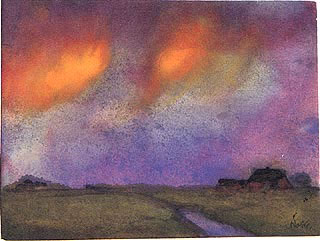 One of Nolde's Unpainted Pictures
About a month and a half ago, I checked out "Unpainted Pictures" from the school library. The book contains the work Nolde was forced to do, basically under house arrest. He called these tiny watercolors unpainted pictures. They are mostly landscape and figural paintings that possess the intensity of Chagall's colors. The figural paintings almost always seem to be representing people acting furtively in body language or with their gazes in very tiny formats that accentuate the message they send that is obviously Nolde's message of confinement. The last time I checked out this book, I didn't notice one little tidbit: a copy of the letter from August 23, 1941 from the president of Reichsknunstkammer, Adolf Ziegler, to Emil Nolde, prohibiting him to practice art. I probably didn't notice it the first time because it is in German (which I don't read or speak) and because the caption is in such small type. Well, I found it this time. Luckily, I have a friend and colleague whose mother is German. Recently, she translated it and I thought I'd share it here.... (special thanks to Cindy's mom, and to Cindy)
The President Berlin, August 23, 1941
of the Reichsknunstkammer
(Governmental Chamber)
of Art
Reference number: II B/ M2603/1236
Mr. Emil Nolde
Berlin-Charlottenburg 9 Registered Mail!
Bayernallee 10
Following the Fuhrer's order to eliminate works of "Entartete Kunst" (degenerate art) found in museums, we had to seize 1052 works by you alone. Many of these had been part of the exhibit "Entartete Kunst" in Munchen, Dortmund and Berlin.
These facts demonstrate that your works do not meet the standard expected from all artists active in Germany since 1933. These include the artists residing here of other nationalities and from other countries. You should be familiar with repeatedly voiced instruction as for the direction and goals of future artistic endeavors that show responsibility towards land and people. Speeches relative to this were given by the Fuhrer at the openings of the "Grossen D.K." ("Important German Exhibits of Art") in Munchen.
By looking at your original works of late we received, we believed that even now you do not follow these cultural principles necessary for your artistic activity in this country and for membership in any governmental chamber ("Kammer").
Based on the First Decree of .... re: "Acts of Governmental Chamber (Reichs....) of 11/1/33 (RGB1.I, S.797) we have to exclude you from the Governmental Chamber of Art since you don't display necessary responsibility. We also won't permit you to -- as of this day -- pursue any professional and extra-professional activities in the field of art.
The membership book of my chamber ("Kammer") M2603 is now invalid in your name. Return it to me by return of post.
Signed Ziegler
Notarized: Dohmling
__________________________________________
So, how's that for unmitigated gall? Even though Nolde originally subscribed to the Nazi party platform, I do feel very sorry for him. This was a painful pill to swallow--wrapped in Karma. Ouch.
Still, if I were Nolde, I would have taken the letter, ripped it up and rearranged it in some aesthetic way, painted over it in my usual prohibited style, framed it, and written my own little letter on the back before mailing it back to Ziegler. My letter would have gone a little like this:
Dear Ziegler,
So, you are going to kick me out of the club and tell me to quit making art? Are you going to take my toys and kick sand in my face too? Maybe you'll bully me for my lunch money too? I triple-dog-dare you! That's right, the dreaded triple-dog-dare! You're not the boss of me! So take that!
Signed, Gonna-make-art-whether-you-like-it-or-not
Then, I would have wrapped it like a present and mailed it back to him.
What would you have done?
Of course, Nazi-approved art was absurd as fine art. At best, the 2-D stuff was decent illustration reminiscent of comic book styles. Both the 2-D and the 3-D stuff had a hint of classical style. Can someone explain to me why Fascist movements gravitate toward neo- or pseudo-classicism in the visual vocabulary of their art and propaganda? I would love to know. It's almost entirely consistent across the board. If you'd like to read an interesting book and view some of the Nazi-approved art, Peter Adam's book "Art of the Third Reich" is a disturbing page turner. Most of the work looked like a Stepford Wife drew some comics. The rest is homoerotic art in the language (on the surface) of classicism. Very bizarre.
Here's another great link for additional information.
Friday, March 31, 2006
Kinkade Watch: Apparently He's an "Idol" to the Women Who Sell His Work
...amongst other things.
Here are some notable quotes in the article from the critics. I agree 100%.
Here are some notable quotes in the article from the critics. I agree 100%.
The critics on Kinkade
"A Kinkade painting was typically rendered in slightly surreal pastels. It typically featured a cottage or a house of such insistent cosiness as to seem actually sinister, suggestive of a trap designed to attract Hansel and Gretel. Every window was lit, to lurid effect, as if the interior of the structure might be on fire. The cottages had thatched roofs, and resembled gingerbread houses. The houses were Victorian and resembled idealised bed-and-breakfasts ... "
Joan Didion
"[One painting] features mountains and quiet shadows and the purple cloak of sunset, but it could just as easily have featured a lavishly blooming garden at twilight, or maybe a babbling brook spanned by a quaint stone bridge, or a lighthouse after a storm; it's hard to distinguish one Kinkade from the next because their effect is so unvarying - smooth and warm and romantic, not quite fantastical but not quite real, more of a wishful and inaccurate rendering of what the world looks like, as if painted by someone who hadn't been outside in a long time."
Susan Orlean, the New Yorker
"There's always been starter art, but Kinkade is the lowest form of starter art I've ever seen."
San Francisco gallery owner
_____________________________________________________________
What I find most entertaining about Kinkade is his insane ego. These quotes are quite revelatory:
-- "He denied the harassment allegation, but said in a deposition: "You've got to remember, I'm the idol to these women who were there. They sell my work every day, you know. They're enamoured with any attention I would give them. I don't know what kind of flirting they were trying to do with me. I don't recall what was going on that night."
In his email he said that long after "this absurd negativity" had subsided, "I will still be here, sitting in front of my easel, trying my best to share the light."
-- "The No 1 quote critics give me is, 'Thom, your work is irrelevant.' Now, that's a fascinating, fascinating comment. Yes, irrelevant to the little subculture, this microculture, of modern art. But here's the point: My art is relevant because it's relevant to 10 million people. That makes me the most relevant artist in this culture."
Hey Thom, I have a newsflash for you. Modern art is not a subculture NOR a microculture, that is, unless your ego is astronomically big enough to transcend the present time and space and the world revolves around you. Modern art began with Manet (middle of the 1860s), and incidentally, we've been in the Postmodern Art age for almost 40 years now. You might want to catch up. You sell sentimentality and manipulate with false comfort. Art isn't art because it's popular. Art is art because it's significantly reveals the depths of the people of a culture of a specific time and place. People love Precious Moments figurines, Beanie Babies, and paintings-by-numbers, but that doesn't make those things art.
Sunday, December 04, 2005
My Favorite Painting of ALL Time
 "Judith and Her Maidservant with the Head of Holofernes,"
 by Artemesia Gentileschi, oil; 72.5" x 55.75"
(click picture to enlarge)
(click picture to enlarge)
One of the most common questions I get as an artist/art teacher is "What is your favorite piece of art of all time?" You'd think that this would be a very difficult question to answer, but until I change my mind, this painting by Artemesia Gentileschi is the one for me.
First, you have to know the story of Judith. Click here to read an article on her on wikipedia.org. Consider the size of the painting. It is life size. Imagine coming upon this image in the museum and your eye level is just about where Judith's hand that holds the sword is. Can you avoid feeling like you've stumbled onto a homicide in progress with the dramatic lighting and the blood red curtain in the background? Judith holds out her hand as if to tell her maidservant to be quiet or to block the light from revealing her face. There are a series of interlocking compositional diagonals of light and shadow as well as the position of the figures' limbs and drapery that simultaneously imply action and the nervous stability of being frozen where you stand. Holofernes is barely a "participant" in this composition. His lifeless head is all that is left of him and lies parallel to the horizontal bottom edge of the painting. Judith's maidservant is in the process of bagging or covering the man's head before someone catches the women. Both women are determined yet dispassionate.
The picture has a high degree of realism until you look closer. If the tiny flame on the candle is the only source of light, then it is putting out far more light than is actually physically possible. Also, the placement of the candle is confusing. Is it to Judith's right? Or is it in front of her? The placement of her left hand in relation to the candle creates confusing space in which the candle is both beside her and ahead of her, but the light on her hand indicates it should be straight ahead of her. One can only assume the artist used a second source of light based on these facts and the fact that more of a shadow should be cast by Judith onto her maidservant if the candle is the sole source of light. This slight tweak of space and light enhances the tension of the image. With these idiosyncrasies, this image has captured my attention for a long time with its dramatic lighting, its expression of time, and its dramatic subject matter.
First, you have to know the story of Judith. Click here to read an article on her on wikipedia.org. Consider the size of the painting. It is life size. Imagine coming upon this image in the museum and your eye level is just about where Judith's hand that holds the sword is. Can you avoid feeling like you've stumbled onto a homicide in progress with the dramatic lighting and the blood red curtain in the background? Judith holds out her hand as if to tell her maidservant to be quiet or to block the light from revealing her face. There are a series of interlocking compositional diagonals of light and shadow as well as the position of the figures' limbs and drapery that simultaneously imply action and the nervous stability of being frozen where you stand. Holofernes is barely a "participant" in this composition. His lifeless head is all that is left of him and lies parallel to the horizontal bottom edge of the painting. Judith's maidservant is in the process of bagging or covering the man's head before someone catches the women. Both women are determined yet dispassionate.
The picture has a high degree of realism until you look closer. If the tiny flame on the candle is the only source of light, then it is putting out far more light than is actually physically possible. Also, the placement of the candle is confusing. Is it to Judith's right? Or is it in front of her? The placement of her left hand in relation to the candle creates confusing space in which the candle is both beside her and ahead of her, but the light on her hand indicates it should be straight ahead of her. One can only assume the artist used a second source of light based on these facts and the fact that more of a shadow should be cast by Judith onto her maidservant if the candle is the sole source of light. This slight tweak of space and light enhances the tension of the image. With these idiosyncrasies, this image has captured my attention for a long time with its dramatic lighting, its expression of time, and its dramatic subject matter.
© Stephanie Lewis, 2005
Monday, November 07, 2005
Dreams, Nightmares, and Memories

My advanced painting class is working on their fourth painting: "paint a dream or a memory." The assignment also includes nightmares, "out of body experiences," hallucinations, and other levels of "consciousness (or "unconsciousness," as it were)." These things are nebulous things to capture in the mind, much less in paint. One of my favorite dream/nightmare images is Dorothea Tanning's "A Little Night Music."
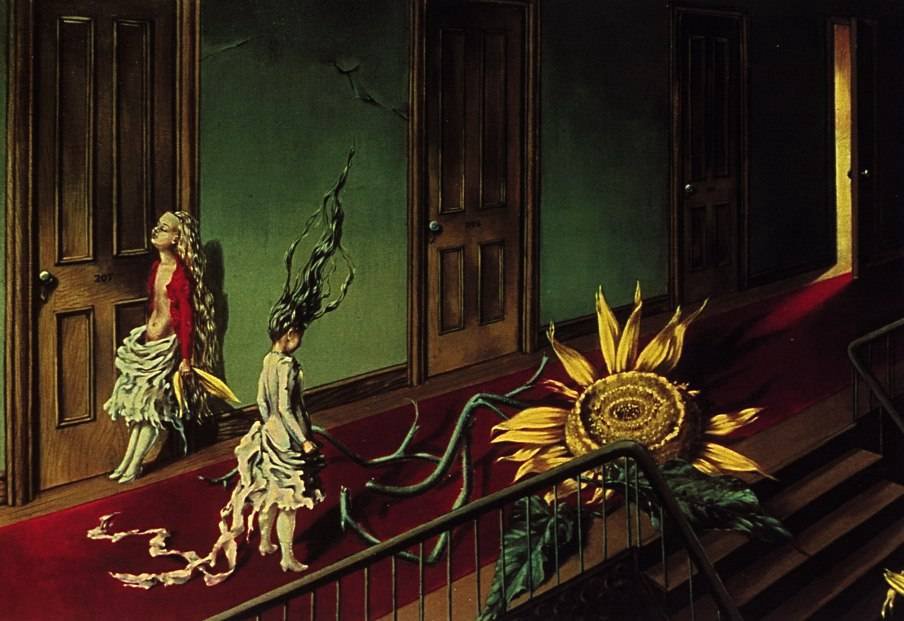
This work has always captivated me. I believe GOOD art asks questions of the viewer and doesn't merely provide the answers or is "eye candy." I think GOOD art is a seduction of sorts. This painting has a series of strange juxtapositions that make it quite compelling: the child, partially clad, leaning against the doorway; another, with her back turned to the viewer--her hair is flying straight into the air; the giant sunflower in the red-carpeted hallway that leads the viewer's eye directly to another room with the door propped open and a mysterious light emitting from the opening; and stairs that run off the format with a dominant, activating diagonal running through the center of the composition. It's quite a disorienting image. It could be a dream, a memory, a salacious nightmare, or an allegory of puberty. What makes this image so compelling and such GOOD ar,t is that its possible meanings exist on so many different levels.
Read a summary of the piece at the Tate and check out other work by Dorothea Tanning.
Sunday, November 06, 2005
R.C. Gorman 1931-2005
 Andy Warhol portrait of R.C. Gorman
About 11 years ago, I worked for a frame store that also sold numbered fine art prints. That year, R.C. Gorman was very big. I could see the decorative appeal of the work, but I didn't know much about him as a person or an artist. His nickname was "The Picasso of American Indian Art." I'm not sure what that nickname is referring to-- his style of art or his prolific art-making. He died Thursday, November 3.

Subscribe to:
Posts (Atom)


