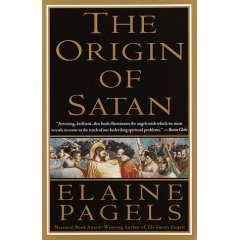
I finally finished this book. It took me so long because it is a lot to chew on, especially when you don't have a lot of time to enjoy a good book. As the title implies, this book gives us the chronicle of the life, history, character, and personality of the being called "Satan." Elaine Pagels does a thorough job as always elucidating complex theology and theological history for the lay person. The entity of Satan has changed numerous times over Judeo-Christian history. This is the history she focuses on and does not address other religions' evil entities.
Satan starts out as part of God's world, employed by him as an obstructor or adversary to human events. He is meant as a challenger as well as a stumbling block:
"Although Hebrew storytellers as early as the sixth century BCE occasionally introduced a supernatural character whom they called the satan, what they meant was any one of the angels sent by God for the specific purpose of blocking or obstructing human activity. The root (of the word) means "one who opposes, obstructs, or acts as adversary." (The Greek term "diabolos," later translated "devil," literally means "one who throws something across one's path.")"
In this version of Satan, he is not necessarily malevolent, "as the literary scholar Neil Forsyth says of the satan, "if the path is bad, an obstruction is good.""
So, here begins the character history of Satan. Even his name is lowercase as if it is a job description and not a reflection of the entity's character. Gradually, as Pagels explains through the book, Satan began to take on personhood, became prideful, fell, became malevolent, was an outsider ("other"), took on a spiritual dimension, then was someone on the inside of a group or a person, and ultimately is engaged in cosmic battle with God and his angels. This does not really contradict the religious story that much. What's interesting to observe is what corresponds with these changes in the character of Satan.
When he is an adversary or stumbling block, the ancient Jews are struggling. He is the satan, not Satan. He is the person who works for God who keeps them from accomplishing their goals and guides them in the correct direction, even if it is painful. During the Maccabean wars, some Jews were dissatisfied with the breakdown of their community. It is this period in which Satan falls from grace, becomes a spiritual being, and is defined as an
enemy -- during a time of war. The first time a spiritual battle between Satan and God is explored is when the Essenes divide from the mainstream Jewish people and try to follow their own legalistic precepts. Their personal battle is moralistic -- so a battle in heaven
must be going on. During early Christianity, Satan vacillates from being the enemy without and within at the same time the Jews are being taught as outside God's plan unless they accept Christ. The Jews, to Christians, are at once, brothers of early Christians (since a lot were Jewish), and outsiders because they won't become Christian. This builds up the idea of a spiritual battle even more. Then, Satan is portrayed as an outsider during the persecution of the early church--which comes as no surprise as the Pagan government was responsible, and they were not like the early Christians--they were "other (outside)". After the early church is established, heretics rise in the ranks to question official church doctrine. It is then that Satan moves within again. The spiritual battle is in full force within the church. After the various protestant sects emerge and the world is proliferated with dozens of Christian denominations, Satan becomes the leader of a COSMIC battle without and within--determined to destroy the church and all believers (indeed, the world) in a final apocalyptic battle.
This is a crude summary, but hopefully, the reader will get the pattern I got. Satan starts out as a minor annoyance and teacher at worst to the future destroyer of mankind. That's quite a change in character over the span of about 2000 years. It seemed to me, after reading Pagels' book that we humans, who have a tendency to make God in OUR image, have done the same with Satan. If we are just struggling, Satan is a pain. If our families are disintegrating, Satan is in spiritual battle within the unit. If our cherished institutions are threatened, Satan is in battle with us. If the nature of our beliefs or faith are attacked, he is apocalyptic in his goals. When he was an adversary, his scale was personal and tribal in scope. When the institutional church perceives an attack and other competiting interpretations of faith abound, he becomes COSMIC and destructive.
So, we have over the brief amount of historical time, projected our darker selves onto either a real or imagined being. I've always found it interesting that people blame God or Satan about equally for their behavior or circumstances, and rarely take their own responsibility for these things. Hmmm. Discuss.

Elaine Pagels
© Stephanie Lewis, 2006


